
The All-on-4 dental implant cost is the single biggest reason patients hesitate, and it is also the number that gets distorted the most. You will see one practice advertise $9,995 and another quote you $35,000 for what sounds like the exact same procedure. Both are technically describing All-on-4. The gap between them is where most patients get burned.
The problem is that "All-on-4" is not one fixed price. It is a treatment concept, and the final number depends on the prosthetic material, whether you need extractions or bone work, the sedation type, the implant brand, and where you live. A quote that leaves any of those out is not a real quote. It is a starting point designed to get you in the chair.
This breakdown shows you the real 2026 price ranges, what a complete quote should include, and the specific questions that separate an honest estimate from a bait number.
How much do All-on-4 dental implants cost per arch?
In the United States in 2026, a standard All-on-4 arch with an acrylic hybrid prosthesis typically runs between $15,000 and $25,000 per arch. A premium zirconia arch runs higher, generally $25,000 to $38,000 per arch. National data from CareCredit's 2026 cost guide puts the average around $15,176 per arch for a titanium-acrylic hybrid, with most quotes falling between roughly $11,600 and $27,500.
"Per arch" matters here. All-on-4 is priced per arch, not per tooth, because the entire bridge of 12 to 14 teeth is supported by just four implants. That shared support is exactly why All-on-4 costs far less than replacing each tooth with its own individual implant, which can reach $30,000 to $60,000 or more for a single arch.
The wide spread inside that per-arch range is not random. It tracks two things above all else: the material your final teeth are made from, and how much preparatory work your mouth needs before the implants go in.
How much does a full mouth of All-on-4 cost?
Because All-on-4 is priced per arch, replacing both your upper and lower teeth doubles the base number. A full mouth of acrylic-hybrid All-on-4 commonly totals $30,000 to $50,000, while two arches of premium zirconia can run $50,000 and well beyond once both jaws are restored.
Keep in mind that All-on-4 is full mouth replacement of an entire arch, both upper and lower when you treat both. It is not a partial or per-tooth fix. So when you compare quotes, confirm whether the number you are looking at is for one arch or two. A $20,000 figure means something very different depending on that single detail, and some advertised prices quietly show the single-arch number to look competitive.
If you want to model your own situation before you ever walk into a consultation, the All-on-4 cost estimator at Dental Implant Directory lets you plug in your arch count, material preference, and likely add-ons to get a personalized range. It is a faster way to sanity-check a quote than calling five offices.
Why are advertised All-on-4 prices so much lower than the final cost?
The short answer: headline prices usually quote the cheapest possible version and exclude the things most patients actually need. A "$9,995 per arch" ad almost always prices an all-acrylic prosthesis on four implants and leaves out extractions, the 3D CBCT scan, IV sedation, and often the final permanent bridge itself.
The temporary vs permanent prosthesis trap
This is the most common source of sticker shock. Many advertised All-on-4 prices cover only the temporary set of teeth placed on surgery day. The custom permanent prosthesis, the one you actually live with for the next decade, is quoted separately or added later. Always ask directly: "Does this price include my final permanent teeth, or only the temporary set?"
What gets left off the headline number
The components that frequently appear as separate line items include extractions of any remaining failing teeth, bone grafting or a sinus lift if your jaw lacks the density to anchor the implants, the CBCT scan used for surgical planning, and IV sedation or general anesthesia. Any one of these can add hundreds to several thousand dollars. Bone grafting alone often runs $800 to $3,500.
The fix is simple but non-negotiable. Ask for the all-inclusive price from consultation to final teeth, in writing.
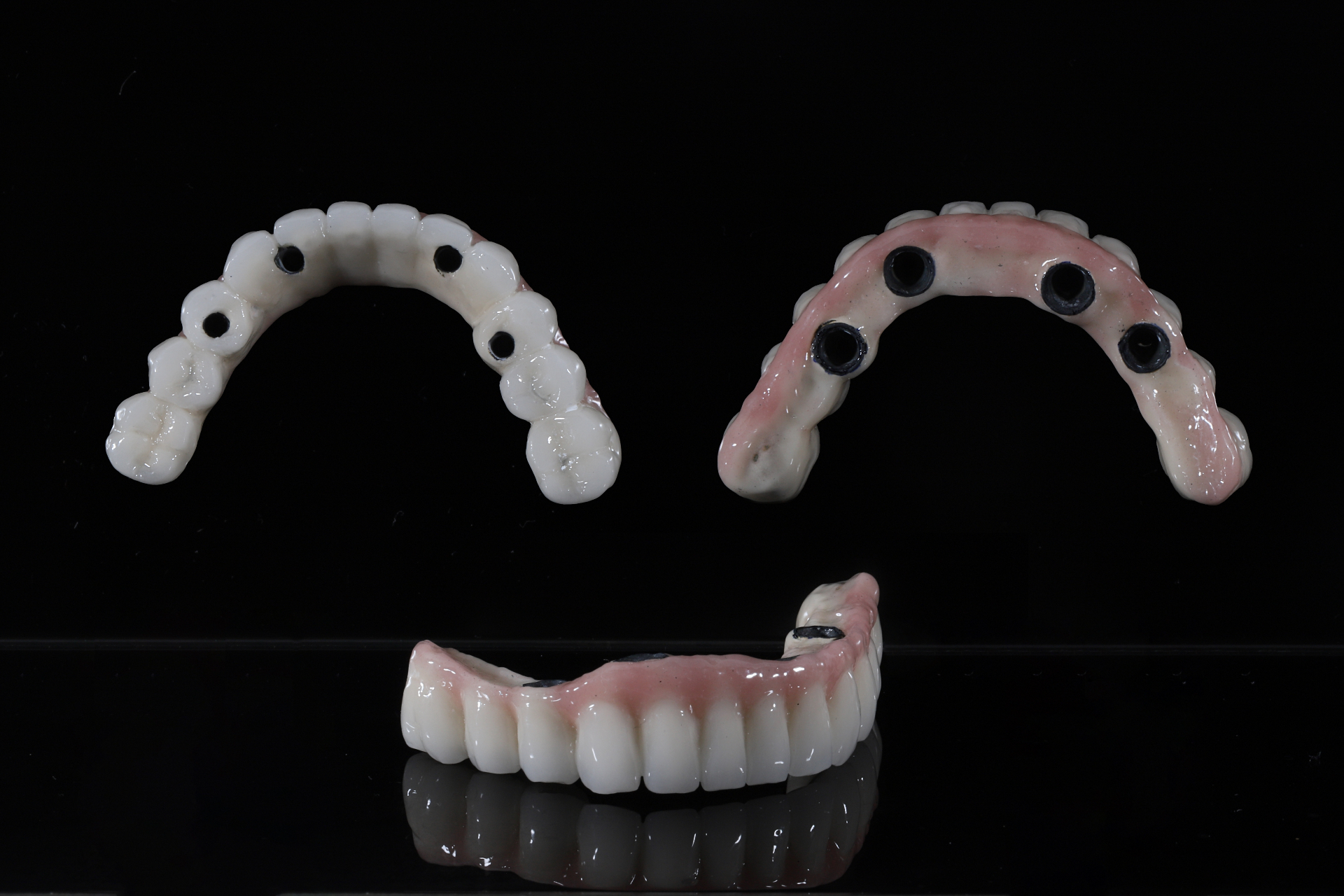
What does the All-on-4 price actually include?
A complete All-on-4 quote breaks into four main components, and understanding them helps you read any estimate critically.
The first is the implants and abutments: the four titanium posts placed in each arch plus the connectors that secure the bridge. Premium brands like Nobel Biocare or Straumann raise this component but come with long-term part availability and, in some cases, a global service warranty.
The second is the prosthesis itself, the custom bridge of 12 to 14 teeth. This is where the acrylic-versus-zirconia decision swings the price the most, often by several thousand dollars per arch.
The third is the surgery and sedation: the surgeon's fee for placing the angled implants, the sterile operating environment, and your anesthesia. Sedation commonly adds around $400 per hour of surgery, and a typical All-on-4 case runs about four hours.
The fourth is the pre-surgical work: the consultation, the 3D CBCT scan, digital planning, and follow-up appointments. Honest practices fold these into the quote or list them transparently. Practices that hide them are the ones to watch.
What drives the price up or down?
Prosthetic material
Acrylic hybrid prostheses are the budget-friendly standard and typically need refurbishment or replacement around the 10-to-15-year mark. Zirconia arches cost more upfront but resist staining and fracture and tend to last longer before replacement. This is the single largest controllable cost lever in your treatment plan.
Bone health and prep work
If you have experienced bone loss, which is common after years of missing teeth or denture wear, you may need grafting before implants can be placed securely. That adds cost and time. Your CBCT scan is what reveals whether this applies to you, which is why skipping it is never a real savings.
Geography
Location moves the number significantly. Major metros and high-cost states run well above the national average. California in particular tends to price above the national average due to higher operating costs, and a full mouth of All-on-4 in California frequently lands at $40,000 to $60,000 or more, not the $19,000 you might see advertised elsewhere.
Provider experience
Specialists such as oral surgeons, periodontists, and prosthodontists generally charge more than general dentists. For full-arch work, that experience often pays off in fewer complications, which protects both your health and your wallet over the life of the implants.

How much does All-on-4 cost in major cities?
City pricing follows the state pattern with a metro premium on top. The averages below come from the city-level data behind the Dental Implant Directory cost estimator and cover one arch, quoted the way practices commonly quote it, without extractions, grafting, or sedation. Each city links to its provider page, where the estimator applies local pricing automatically.
| City | All-on-4 per arch (avg) |
|---|---|
| El Paso, TX | $25,900 |
| San Antonio, TX | $26,800 |
| Fort Worth, TX | $27,600 |
| Dallas, TX | $28,200 |
| Austin, TX | $28,500 |
| Fresno, CA | $35,400 |
| Sacramento, CA | $36,800 |
| San Diego, CA | $39,200 |
| Los Angeles, CA | $39,500 |
| San Jose, CA | $41,200 |
| San Francisco, CA | $42,000 |
For cities not listed, the state-by-state cost guide gives the state average, and the city page for any listed city shows local providers with the estimator set to that state.
Does insurance cover All-on-4, and how do people pay for it?
Most US dental plans treat All-on-4 as cosmetic or elective and will not cover the procedure itself. That said, a plan with strong major-restorative coverage may pay part, and related steps like extractions or grafting are sometimes covered at roughly 50 percent up to your annual maximum. One legitimate strategy is staging treatment across two calendar years to tap two annual insurance maximums.
For the balance, most patients use financing rather than paying the full amount upfront. Healthcare credit cards like CareCredit offer promotional interest-free periods on qualifying balances. Dedicated dental lenders fund five-figure full-mouth cases at fixed rates. Many practices offer in-house monthly payment plans. And because implants are an IRS-eligible medical expense, HSA or FSA pre-tax dollars effectively cut your real cost by your tax rate.
Keep in mind that financing benefits vary widely by practice, and the availability of any specific plan is something to confirm directly with the provider, not assume from an ad.
How can I compare All-on-4 quotes fairly?
Use these questions to put every quote on equal footing before you commit:
- Is this price for one arch or both arches?
- Does it include the final permanent prosthesis, or only the temporary teeth?
- What material is the final bridge, acrylic hybrid or zirconia?
- Are extractions, bone grafting, the CBCT scan, and sedation included or separate?
- What implant brand is being used?
- What is the total all-inclusive price, in writing, from consultation to final teeth?
If a practice will not answer all six clearly, that itself is your answer. For more on separating qualified providers from heavy marketing, see how to choose a dental implant provider, and browse the rest of the Dental Implant Directory blog for guides on candidacy, recovery, and what to verify before a major procedure.
The Bottom Line
All-on-4 dental implant cost in 2026 realistically runs $15,000 to $25,000 per acrylic arch and $25,000 to $38,000 per zirconia arch, with a full mouth landing anywhere from $30,000 to well over $60,000 depending on material, location, and the prep work your case requires. The advertised numbers are almost always the floor, not the final figure, so the smartest thing you can do is demand an all-inclusive written quote and compare apples to apples. Run your own numbers first with the All-on-4 cost estimator so you walk into every consultation already knowing what a fair range looks like. And when you are ready, find qualified providers near you at Dental Implant Directory.
Ready to find a qualified provider?
Search our independent directory of dental implant providers organized by specialty, location, and credentials.