How ads in ChatGPT work, what OpenAI allows for dental services, what they cost, and whether an implant practice should be an early advertiser.
A growing share of implant patients no longer start with a Google search. They open ChatGPT and type the whole question: "I've lost most of my upper teeth, what are my options and how much does All-on-4 cost in Phoenix?" They get a long answer, ask three follow-ups, and arrive at a practice's website already knowing what zygomatic implants are. For a decade the only way to reach that patient was to rank in Google. In 2026, OpenAI started selling ads inside those conversations.
The platform is new, the rules are still moving, and healthcare is one of the categories OpenAI reviews by hand. Most implant practices have not looked at it yet, which means a few early advertisers are already in, and the inventory is cheap because the auctions are nearly empty.
This post explains how ads in ChatGPT work today, what OpenAI's policy says about dental services, what the targeting and pricing look like, and the advantages and disadvantages for an implant or All-on-4 provider deciding whether to be early.
How do ads in ChatGPT work?
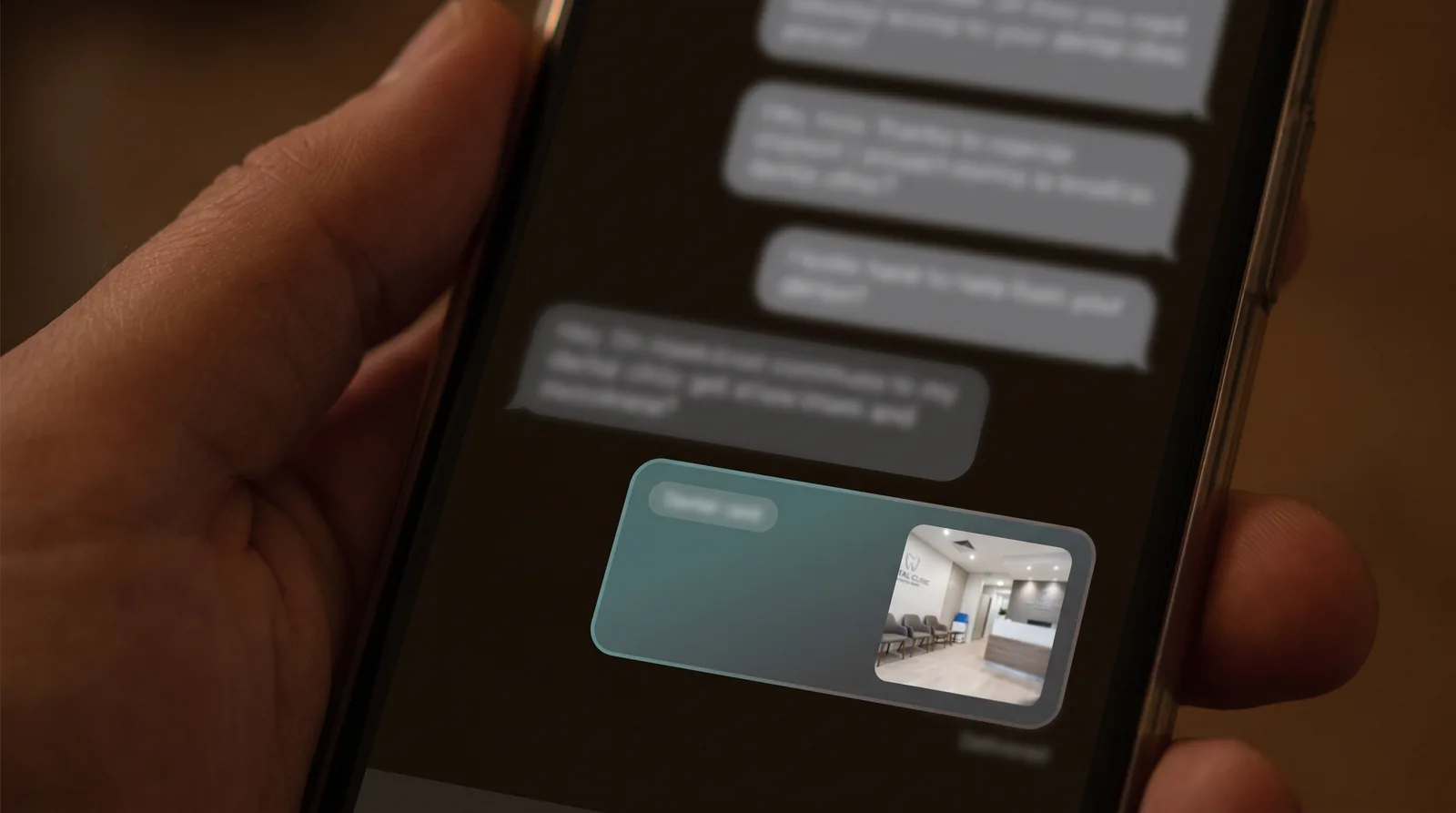
Ads appear at the bottom of a ChatGPT response in a clearly labeled sponsored unit, and only for logged-in adult users in the United States on the Free and Go subscription tiers. Paid tiers, meaning Plus, Pro, Business, Enterprise, and Education, do not see ads at all. The ad does not change what ChatGPT says; advertisers cannot influence the answer, and OpenAI states that advertisers never receive the user's chats, memories, or sensitive information.
OpenAI began testing ads with US users in early 2026 and opened a self-serve ads manager during the year. By late summer it was describing the product as a global platform with tens of thousands of advertisers across more than 60 countries, though ad eligibility for health services remains US-only.
What does the campaign structure look like?
Anyone who has run Google or Meta ads will find it familiar. Campaigns contain ad groups, which contain ads. The available objectives are Reach, Clicks, and Conversions. Buying is on a cost-per-click or cost-per-thousand-impressions basis with no minimum spend. Conversion tracking runs through an OpenAI pixel placed on your website, and reporting covers impressions, clicks, spend, click-through rate, and average cost per click and per thousand impressions, broken down by day.
How does targeting work?
Targeting is contextual rather than personal. OpenAI matches ads to the topic of the conversation, with no cookies and no user profile, and you can narrow delivery by country, region, and city, which is what makes the platform usable for a local practice. Customer-match style audiences are available for advertisers who upload their own lists. What you cannot do is bid on a keyword in the Google sense; you describe the topics and products your ad is relevant to, and the system decides which conversations qualify.
Does OpenAI allow dental implant practices to advertise?
Yes, with conditions. OpenAI's ad policies list healthcare and medicine as a category where ads may be approved from approved advertisers, rolled out gradually with manual case-by-case review, and dental services is specifically named among the permitted US subcategories alongside hospitals, health insurance, and vision products. Advertisers may be asked to provide proof of licensure, and ads for health services outside the US are generally prohibited.
The sensitive-conversation limit
This is the part that matters most for an implant practice. OpenAI's help documentation says ads are not eligible to appear near sensitive topics, including personal health, and during the initial test phase ads did not run in chats about health at all. A July 2026 policy update then stated that medical, legal, and financial advice contexts are no longer categorically blocked by default, while sensitive conversations remain ineligible.
The practical reading is that a conversation about a person's own symptoms, pain, or medical history is likely to be treated as sensitive and carry no ads, while a conversation about the cost of All-on-4 in a city, or how to compare implant providers, may well be eligible. Exactly where that line falls is not published and will keep moving. An implant practice should expect that a meaningful share of the conversations it would most like to appear in are off limits, and that the eligible inventory is the comparison and cost research rather than the clinical questions.
Approval is manual
Because healthcare is reviewed by hand, expect the application to take longer than opening a Google Ads account, and expect to supply your dental license and practice details. Build that into the timeline rather than planning to launch in a week.

What are the advantages of ChatGPT ads for an implant practice?
The case for being early comes down to nearly empty auctions, a patient who arrives further along than a Google searcher, a format that national chains cannot simply outbid, and the chance to learn the platform before the competition does.
The auctions are the most concrete advantage. Google Ads for dentists averages $8.00 per click in 2026, with full-arch terms in major metros reaching $20 to $30. ChatGPT's self-serve platform is months old and most dental advertisers have not applied, and cost per click on a new ad platform is historically lowest in its first year, before the agencies arrive. No dental-specific benchmarks exist yet, which is itself evidence of how few practices are there.
The patient is also deeper into their research than a typical searcher. Someone who has spent twenty minutes asking ChatGPT about bone grafts, immediate load protocols, and zirconia versus acrylic bridges is not browsing casually. They are the patient every implant practice says it wants, and they are reading a long-form answer when the ad appears rather than scanning ten blue links. City and region targeting means a single-location practice in Tampa is not paying to appear for a user in Seattle, which is the minimum requirement for the channel to make sense, and it is in place.
There is a structural advantage for independents too. In Google search, a national implant chain can take the top slot in your city by paying for it. In ChatGPT the ad does not displace the answer, and contextual matching with no keyword bidding makes exclusivity harder to buy, so an independent practice with a strong offer and a relevant landing page is on more even footing. And platforms reward advertisers who understand them before the crowd does; a practice that has spent six months learning what converts in ChatGPT will be running a tuned campaign when agencies start selling it to every competitor in town.
What are the disadvantages of ChatGPT ads for an implant practice?
The risks are limited and unpredictable inventory, no keyword control, thin reporting, an unproven conversion path, and a policy environment that can change between quarters.
The inventory you want may simply not exist. If conversations about a user's own teeth are classed as sensitive, your ads will run next to cost comparisons and provider research but not next to "my dentist says I have too much bone loss for implants." Free and Go tier users are also the only audience, which excludes everyone who pays for ChatGPT, a group that likely skews toward the higher-income patient an implant practice is after.
There are no keywords and no search terms report, so you cannot see which conversations triggered your ad or exclude the ones that should not have. Google's search terms report is the main tool for fixing a dental campaign's lead quality, and nothing equivalent exists here yet. Reporting is basic as well: impressions, clicks, spend, and rates by day, with no conversation topics, demographics, or placement detail. The OpenAI pixel gives you conversions on your site, which is enough to compute cost per lead but not enough to diagnose why.
Nobody knows the conversion rate either. There is no published data on how a ChatGPT ad click converts to a booked consult for dental, or for anything local. The patient may be deep in research or may be a student writing a paper, and the only way to find out is to run it with full tracking. And the rules will keep moving. OpenAI revised its ad policy several times in 2026, and healthcare went from fully blocked to case-by-case within months. A category can tighten as easily as it loosened, so budget for this as an experiment rather than a dependable channel.
How should an implant practice test ChatGPT ads?
Apply early, start small, track everything, and point the ads at a page built for a patient who already understands the procedure. The goal of the first 90 days is to learn the cost per booked consultation, not to scale.
- Apply now, with your license documentation ready, since healthcare approval is manual and the queue length is unknown.
- Install the OpenAI pixel and confirm it fires on your consultation request and phone-click events before spending a dollar, and add call tracking so phone consults from this traffic are attributed.
- Target your metro only, and start with a Clicks or Conversions objective and a budget you can afford to lose entirely, somewhere in the range of $500 to $1,500 a month.
- Write the ad for the researched patient. Lead with specialist credentials, a transparent price range, and financing rather than "free consultation," because this reader has already been told what the procedure is.
- Send the click to your dedicated full-arch page rather than the homepage, so the long-form reader finds the long-form answer. The structure of a [full-arch landing page that converts](/grow-your-practice/blog/full-arch-landing-page-that-converts) fits this traffic well.
- After 60 to 90 days, compare cost per booked consult with your Google Ads and [Bing Ads](/grow-your-practice/blog/google-ads-vs-bing-ads-dental-implants) results. Scale if it wins, hold at the test budget if it is close, and cut it if the clicks do not book.
Prepare for the organic side too
ChatGPT also answers "best dental implant provider in [city]" without any ads, and it draws on directories, review sites, and well-structured practice pages to do it. A practice that is listed on the comparison pages ChatGPT cites appears in those answers for free. That is part of the case for directory listings for implant practices, and it is the cheapest way to be present in AI answers while the paid side matures.

The Bottom Line
Dental services are an approved category for ads in ChatGPT, subject to manual review and licensure, but ads stay away from personal health conversations, which removes a large share of the implant inventory a practice would want. What remains is cost and provider research from a patient who is already well informed, in auctions that almost no dental advertisers have entered. That is worth a small, well-tracked test for any practice with a strong full-arch page and the patience to learn a new platform, and not worth a large budget until the conversion data exists. And to appear in the answers ChatGPT gives without ads, list your practice on Dental Implant Directory.
Get found by implant patients
Join the directory and start receiving qualified inquiries in your area. Plans start at $19.99/month.
Explore Listing Plans