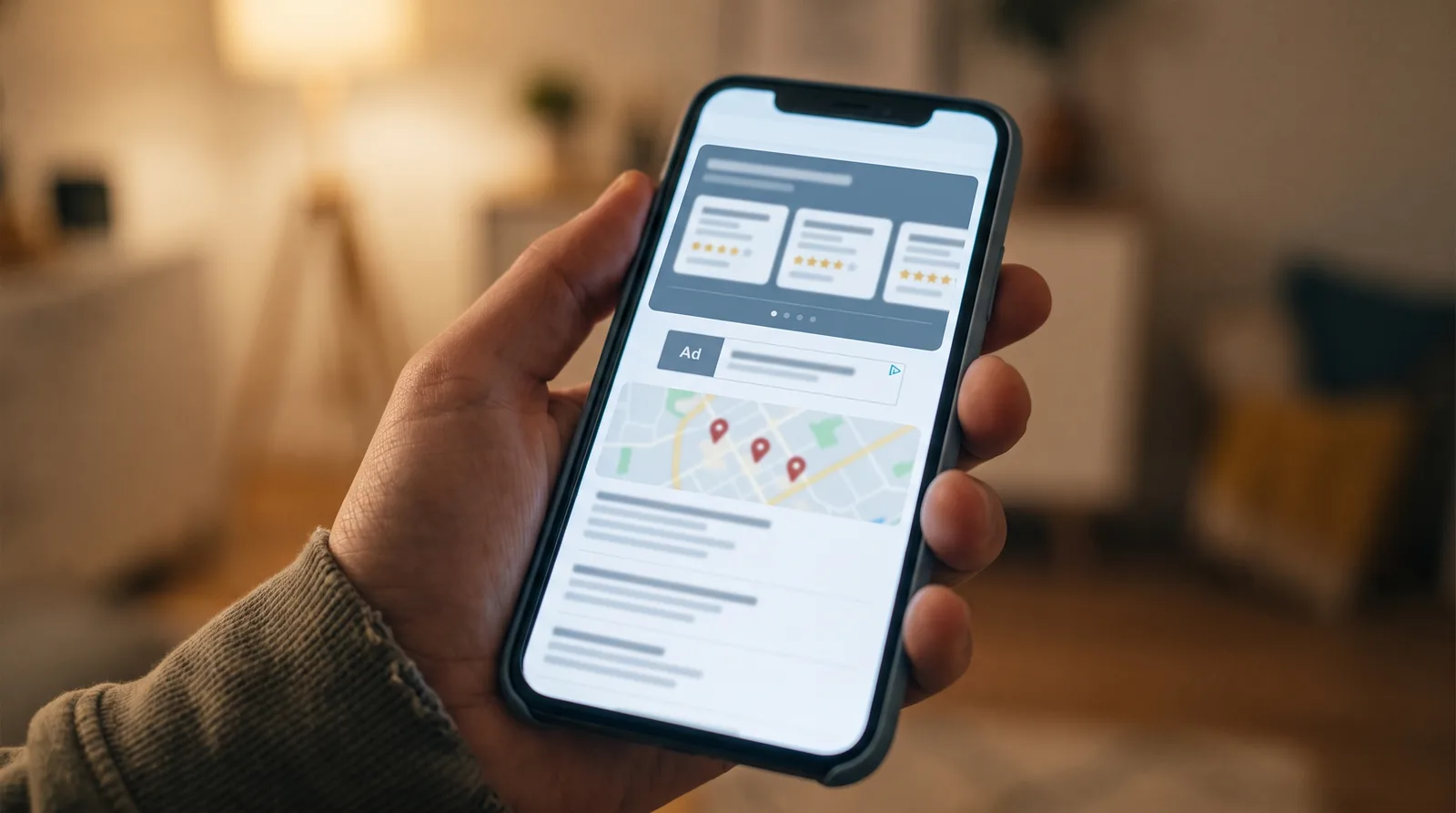
A click-share breakdown of the dental implant search results page, and what it means for where an implant practice should spend first.
Every implant practice in your city is paying for the same page. When a patient types "dental implants near me," Google serves a single results page, and there are only four places on it where a practice can appear: the Local Services Ads box at the top, the text ads beneath it, the Local Pack map, and the organic listings below that. Whatever you spend on marketing is, in the end, a bet on which of those four units the patient taps.
The trouble is that most practices place that bet on instinct. The agency says paid search is fastest, the consultant says SEO is cheapest, and the Google rep says Local Services Ads are the newest thing. None of them show you the click data, even though it exists, and it does not favor the channel that gets the most attention.
This post walks through where the clicks actually go on a local implant search, what it costs to win each of the three channels, and the honest advantages and disadvantages of each for a practice selling $20,000 to $50,000 cases.
Where do the clicks go on a dental implant search?
When every unit is present on a local service search, the clicks split like this:
- Organic listings: 43.9%
- Local Pack (the map and the three businesses under it): 28.8%
- Local Services Ads: 13.8%
- Pay-per-click text ads: 11.4%
- Taps on the map itself: 2.0%
Those figures come from BrightLocal's Local Services Ads click study, which monitored 5,500 local searches and remains the only dedicated LSA click study ever published.
Two things stand out immediately. The two paid units combined, LSAs plus text ads, take about a quarter of the clicks, 25.3% in total. The three free units, organic, the Local Pack, and the map, take the other three quarters. And the single largest slice on the page, organic, is the one that costs nothing per click.
The study covers local service searches in general rather than dental specifically, and ad units have grown heavier since it was published, so the numbers are best treated as directional. Two anchors do hold up in later data, though: organic's share falls from roughly 50% to roughly 44% when the LSA box appears, and total paid clicks rise from 14.6% to 25.3% in that same scenario.
How often does each unit even show up?
The layout is not fixed from one search to the next, and this is where most practices' assumptions go wrong. A May 2026 WebFX study of 500 local service searches found that the Local Pack appeared on 98% of them, the LSA box on only 28% overall (49% of searches that named a city), and text ads at the top on just 8%. Whenever the LSA box does appear, it takes position one.
So the Local Pack is the one constant on the page. Local Services Ads are present on somewhere between a quarter and a half of searches, depending on how patients phrase them. Text ads at the top are far rarer than most practices assume, and on every search without an LSA box, organic's share climbs back toward 50%.
What this means for an implant practice
The patient is going to tap something on this page. If you only buy text ads, you are competing for roughly 11% of the clicks. If you only run LSAs, you are competing for roughly 14%, and only on the searches where the box happens to appear. If you have no organic presence and no optimized Google Business Profile, you are absent from the three quarters of the page that patients tap most.
That reframes the question. Instead of asking which channel is best, the useful question is which units you are missing and what it costs to show up in each.
What are the advantages and disadvantages of Local Services Ads for implant practices?
Local Services Ads put your practice at the very top of the page with a Google Screened badge, and you pay per lead rather than per click. That is the strongest position available, and the pricing model protects you from wasted clicks. The tradeoffs are limited control, an inconsistent presence on the page, and a lead mix that leans toward general dentistry.
Advantages
The pay-per-lead model is the headline. A phone call or message request is what triggers a charge, and leads that turn out to be spam or outside your service area can be disputed. Agency-reported cost per lead for dental LSAs clusters around $30 to $65, with a wider range of $20 to $95 depending on market density. Compare that with the $72.97 average cost per lead on Google Search for dentists in WordStream's 2026 benchmarks.
Beyond price, the LSA unit has a few things going for it that no other channel can match:
- Position one is yours whenever the box appears, and nothing a competitor buys in text ads can sit above it
- The Google Screened badge carries real trust, because Google verifies licensure and runs background checks before approving a practice
- Setup is simple, with no keywords, no ad copy, and no landing page to build
Disadvantages
The central problem is that you cannot target "All-on-4" or "full arch." LSAs match on broad service categories, so a practice built around full-arch cases will receive cleanings, extractions, and emergency calls alongside implant inquiries. Every one of those is a billable lead unless you dispute it, and disputes take staff time.
There are three other limits worth understanding before you launch:
- The box only appears on about 28% of local searches, so on the other 72% your LSA budget buys nothing and the page starts with text ads or the Local Pack
- Reviews drive ranking inside the unit, and you cannot buy past a competitor with more of them; a practice with 400 reviews will take most of the calls even on a smaller budget
- There is no landing page, which means no chance to pre-sell the patient on your credentials, pricing, or financing before the call, so the front desk carries the entire conversion
That last point deserves emphasis. If your team is not trained to handle a $25,000 inquiry on the phone, the lead cost is wasted at the moment someone picks up. Verification also takes two to six weeks, and the dental category is new enough that Google's rules still change without much notice.
What are the advantages and disadvantages of Google Ads for implant practices?
Google Ads text campaigns give you more control than any other channel over who sees you and what they read, but they compete for only about 11% of clicks on the page, and the cost per click in dental is the third highest of any industry. Run well, they are the fastest way to reach a patient who is ready to book. Run badly, they are the fastest way to spend $5,000 on single-tooth price shoppers.
Advantages
The thing Google Ads does that nothing else can is let you choose the exact query. "All-on-4 cost," "full mouth dental implants," and "implant dentist near me" each signal a different patient, and you can bid on the ones that match your case mix while excluding the ones that do not.
You also control the message. The ad can name your price range, your financing, your specialist credentials, and your same-day option, and the landing page can carry the patient the rest of the way. A page built for the full-arch patient converts very differently from a generic implants page, which is why a dedicated full-arch landing page matters as much as the campaign itself. Results arrive in days rather than months, and with conversion tracking in place you can tie every consultation back to the keyword and ad that produced it.
Disadvantages
Dental is expensive, and that is the first thing to accept. WordStream's 2026 data puts the average dentist cost per click at $8.00, behind only attorneys and home improvement, and full-arch terms in major metros run $20 to $30 per click. At a 10% conversion rate, that is $200 to $300 per lead before anyone has booked anything.
The second problem is the size of the slice. Text ads take only 11.4% of clicks on the page, and the top ad slot appears on a minority of local searches, so even a perfectly run campaign is competing for a small share of the patients.
The third is that campaign structure mistakes are common and costly. One generic "dental implants" campaign with broad match keywords and a single service page captures early researchers and price shoppers while missing the high-intent full-arch patient entirely. The reasons most implant practices' Google Ads miss full-arch patients are structural and fixable, but they require someone who knows the implant market, not just the ad platform. And when the spend stops, the leads stop with it; there is no residual value once the budget is paused.

What are the advantages and disadvantages of organic SEO for implant practices?
Organic search wins the largest share of clicks on the page at 43.9%, and the Local Pack, which is driven largely by your Google Business Profile, takes another 28.8%. Together that is nearly three quarters of the page at zero cost per click. The catch is that it takes months to earn a position, and you are competing with directories and national chains that have been building authority for years.
Advantages
Organic is the biggest unit on the page, full stop. It takes more clicks on its own than LSAs and text ads combined, and on searches without an LSA box it approaches half of all clicks. The cost per lead also falls over time, because once a page ranks it produces inquiries month after month with no per-click charge. Practices that invested in content two years ago are now receiving full-arch consultations at a marginal cost close to zero.
The Local Pack, meanwhile, is reachable for almost any practice. It appears on 98% of local searches, and the inputs are a complete Google Business Profile, a steady flow of reviews, and consistent citations. That work is well within reach of a single-location practice, and earning Google reviews for an implant practice is the highest-leverage piece of it. Patients also tend to trust organic results more, since a practice ranking under a comparison-style query carries the implicit credibility of not having paid for the spot.
Disadvantages
Organic is slow. A new implant page typically takes three to nine months to reach page one for a competitive city query, and "dental implants near me" is one of the hardest local queries in healthcare.
The organic slot is also frequently occupied by directories rather than practices. Comparison pages from Yelp, Healthgrades, and Dental Implant Directory rank beside practices under the same query because they match the patient's comparison intent, which means a single practice site is competing against pages that list fifty practices at once. The practical answer is to be listed on those pages rather than to try to outrank them, and that is the argument behind directory listings for implant practices.
Two smaller frustrations round it out. Organic results are harder to attribute, because a patient who found you organically, read three pages, and called a week later shows up in your reports as a direct phone call unless you have call tracking in place. And the work never quite finishes; SEO is not a one-time setup, and the practices that win keep publishing. The full method is in SEO for dental implant practices.
Which channel should an implant practice invest in first?
Start with the units that appear on every search and cost nothing per click: your Google Business Profile for the Local Pack, and your directory listings for the organic slot. Then add Local Services Ads once your review count can support them. Add Google Ads last, and only with a full-arch campaign structure and a dedicated landing page.
That order comes from the click data rather than from any channel's marketing. The Local Pack is on 98% of searches and takes 28.8% of clicks. Organic takes 43.9%. A practice with a strong profile and a presence on the comparison pages is in front of roughly 72% of the clicks before it spends a dollar on ads.
A practical sequence
- Complete and optimize your Google Business Profile, with implant-specific services, photos, and a review request process that produces new reviews every week.
- Claim your listing on the directory pages that already rank for your city's implant queries, so you appear in the organic slot without having to outrank it.
- Apply for Local Services Ads once you have enough reviews to rank inside the box, and train the front desk on the implant phone call before the first lead arrives.
- Launch a Google Ads campaign built around full-arch keywords, with negative keywords for single-tooth and price-shopper terms, pointing to a dedicated landing page.
- Put call tracking in place so every channel's phone calls are attributed, then compare cost per booked consultation, not cost per lead, across all four.
What to measure
Cost per lead flatters LSAs and penalizes SEO, which is why it is the wrong number for an implant practice. Cost per booked consultation and cost per accepted case are the figures that matter when you are selling $25,000 cases, and they often reverse the ranking entirely. A $45 LSA lead that turns out to be an emergency extraction is worth less than a $250 Google Ads lead who booked a full-arch consult. Track the cost per full-arch case by channel, not the cost per inquiry.

The Bottom Line
Patients tap organic listings and the Local Pack far more often than they tap ads, and those two units appear on nearly every implant search. Local Services Ads and Google Ads each have a real place for an implant practice, but they compete for a quarter of the page and cost more per click than almost any other industry. Build the free units first, add paid where your reviews and front desk can support it, and judge every channel on cost per accepted case rather than cost per lead. And when you are ready to appear in the organic slot without waiting for rankings, list your practice on Dental Implant Directory.
Get found by implant patients
Join the directory and start receiving qualified inquiries in your area. Plans start at $19.99/month.
Explore Listing Plans