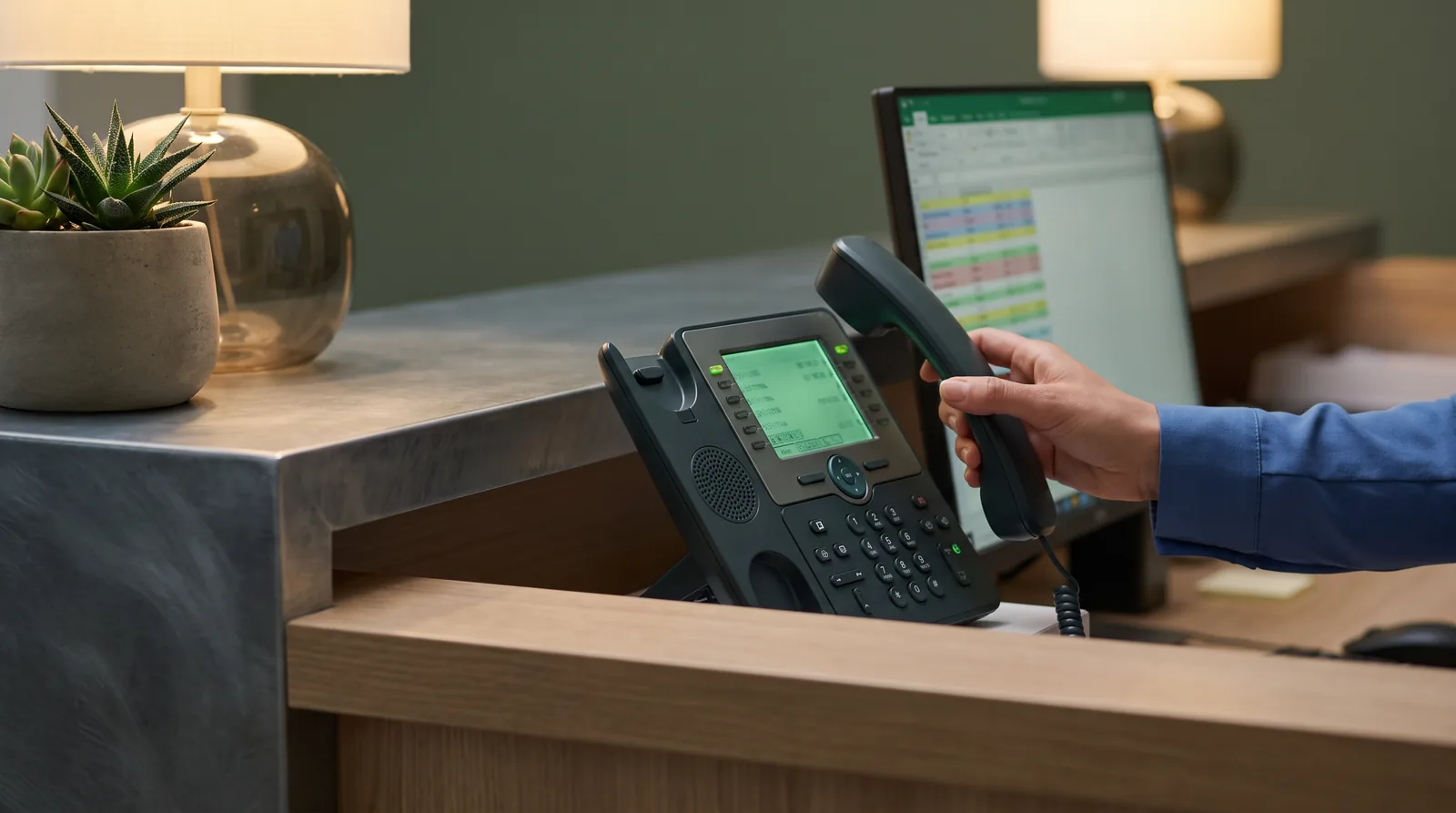
Why most implant practices cannot tell where their consults come from, how call tracking fixes it, and what CallRail costs and requires for a HIPAA-covered practice.
Most implant consultations start with a phone call, and most implant practices have no idea which ad, page, or listing made the phone ring. The agency report shows clicks and form fills. The practice management system shows new patients with "referral source: phone." Between those two sits the majority of the practice's revenue, unattributed, while the budget decisions get made on the small slice of leads that happened to fill out a form.
That gap is why practices keep paying for channels that do not work and cut the channels that do. A Google Ads campaign that produces four form fills and thirty phone calls looks like a failure in the dashboard when it is actually the best thing the practice runs. An SEO investment that produces no form fills and twenty calls a month looks like nothing at all. Call tracking exists to close that gap, and CallRail is the platform most dental marketers use to do it.
This guide explains what call tracking does, how CallRail works for an implant practice, what it costs, the HIPAA requirements that apply, and how to use the recordings to fix the front desk as well as the marketing.
Why can't most implant practices tell where their phone calls come from?
Because every ad, listing, and page shows the same phone number, and a call to that number carries no information about what the patient saw before dialing. The agency can report the clicks it sent, but it cannot see which of those clicks turned into the call that booked a $30,000 case. The front desk asks "how did you hear about us?" and the patient says "Google," which could mean an ad, a map listing, an organic result, or a directory page.
The result is that form fills get credited and phone calls do not, and for implant practices the phone is the main channel. Patients over 55 call. Patients with a $25,000 question call. The channels that produce the most calls are systematically undercounted, which is one of the signs a marketing agency is reporting the wrong numbers, even when the agency is entirely honest.
What does CallRail actually do?
CallRail gives the practice a pool of tracking phone numbers, shows a different one to each visitor depending on how they arrived, and records which source, campaign, and keyword produced each call. It also records and transcribes the calls, scores them, and sends the results back into Google Ads, Google Analytics, and the CRM, so that phone calls finally appear in the same reports as the form fills.
Dynamic number insertion
This is the core mechanism. A small script on your website swaps the displayed phone number based on the visitor's source, so a patient who arrived from a Google Ads click sees one number, a patient from an organic search sees another, and a patient from your directory listing sees a third. All of them forward to your real line, the front desk notices nothing, and every call is now tagged with its source. With the Google Ads integration, CallRail can tag the call down to the campaign, ad group, and keyword that produced it.
Source-level numbers
For places where a script cannot run, such as your Google Business Profile, a print ad, a directory listing, or a Local Services Ads profile, you assign a static tracking number to each one. Calls to that number are attributed to that source.
Recording, transcription, and scoring
Every call can be recorded, with the required announcement, and transcribed. CallRail's conversation intelligence features, available on its higher tiers, summarize calls, flag keywords such as "implant," "All-on-4," or "cost," score whether a call was a lead, and detect whether an appointment was booked. For an implant practice, this is how you learn that the Google Ads campaign produced thirty calls, twelve of which were implant inquiries and five of which booked, without anyone listening to thirty recordings.
Integrations
CallRail sends calls into Google Ads as conversions, so smart bidding can optimize toward calls that booked rather than clicks that bounced. It sends events to Google Analytics 4, pushes leads into CRMs including HubSpot and Salesforce, and connects to automation platforms so a missed call or a short call can trigger a follow-up task.

What does CallRail cost for a dental practice?
CallRail's published plans in 2026 start around $45 to $50 a month for basic call tracking, with conversation intelligence and the AI features on tiers from roughly $90 to $195 a month. Usage charges for numbers and minutes come on top, at about $0.05 per local minute and $0.08 per toll-free minute beyond the included allowance. For a HIPAA-covered practice, the price that actually matters is for a Healthcare account, which is sold through CallRail's sales team rather than self-serve.
The tiers map to two different questions. The base tier answers the attribution question, meaning which source made the phone ring. That alone changes budget decisions and is worth it for any practice spending more than a few hundred dollars a month on marketing. The conversation intelligence tiers answer the quality question: which calls were implant inquiries, which booked, and how the front desk handled them. For a practice selling full-arch cases, that second question is where the money is. Knowing that a channel produced calls is useful; knowing it produced consults is what lets you compute cost per full-arch case by channel.
Usage charges are the main surprise on the bill. A practice receiving several hundred tracked calls a month with recording enabled will exceed the included minutes, so budget for the usage line and not just the plan price.
Is CallRail HIPAA compliant for a dental practice?
CallRail offers HIPAA compliance through its Healthcare plans, which include a signed Business Associate Agreement, restrict access to recordings and transcripts, and add safeguards around stored call data. The standard self-serve plans do not come with a BAA, and sources disagree on exactly what the self-serve tiers include, so the safe assumption is that a dental practice needs the Healthcare account and should get the BAA and the price in writing from CallRail sales before recording a single call.
The reason this matters is simple. A recorded call in which a patient describes their failing teeth, their medical history, and their name is protected health information, and storing it on a platform without a BAA is a compliance problem regardless of how useful the recording is. The Healthcare plan exists for that reason, and the extra cost is small against the exposure.
The practice has obligations of its own as well:
- State that calls are recorded, with an announcement at the start of each call
- Limit who can log in and listen
- Set a retention period and stick to it
- Make sure every tool in the chain that receives call data is also covered by a BAA
That last point catches people out. An automation that pulls call transcripts into a spreadsheet breaks the chain. The HIPAA-native route for those connections is covered in Keragon automations for implant practices.
How should an implant practice use call recordings beyond attribution?
To fix the front desk. Attribution tells you which channel produced the call, but the recording tells you what happened next, and in most implant practices what happens next is where the case is lost.
A practice that listens to ten implant inquiries a month will hear the same things over and over. The patient asks what it costs and the receptionist says they would have to come in. The patient asks whether they are a candidate and the receptionist says the doctor would have to see them. The patient asks about financing and gets a hold tone. None of this is the receptionist's fault, because nobody trained her on a $25,000 call, but the recordings make the problem visible and the training specific.
Once you can hear the calls, you can score them against a standard. Define what a good implant call sounds like: the patient's situation is asked about, a price range is given, financing is mentioned, and a consult is offered with two specific times. Score a sample each week. Conversation intelligence can automate most of this, and the standard itself can be built from the full-arch consultation script.
The recordings also surface two problems that are cheaper to fix than any marketing change. CallRail reports missed calls by source and time of day, so a practice that sees a cluster of missed Google Ads calls between noon and one, or after five, has a staffing fix rather than a marketing one. And for practices running Local Services Ads, the recording is the evidence for disputing a lead that was outside your services or area; tracking numbers on the LSA profile make that routine, and the mechanics are in whether Local Services Ads are worth it for an implant practice.
How do you set up call tracking for an implant practice?
Decide which sources need their own number, install the script, connect the ad platforms, turn on recording with the announcement, and set a weekly review. The setup takes a day; the review is what produces the return.
- Confirm the Healthcare plan and the signed BAA with CallRail before anything else.
- Install the dynamic number insertion script on every page of the website, including the dedicated landing pages, and verify it swaps the number for visits from Google Ads, organic search, and social.
- Assign static tracking numbers to your Google Business Profile, your Local Services Ads profile, each directory listing, and any print or mail piece. If you prefer not to swap the primary number on your Google Business Profile, keep your real number as the primary and add the tracking number as an additional line.
- Connect Google Ads so that calls over a set length, or calls scored as leads, flow back as conversions, and connect Google Analytics 4 and the CRM.
- Turn on recording with the announcement and set keyword spotting for "implant," "All-on-4," "all on four," "dentures," "cost," and "financing."
- Set a weekly review covering calls by source, implant inquiries by source, booked consults by source, missed calls by source and hour, and three recordings scored against the standard.
- After 90 days, rebuild the marketing budget on cost per booked implant consult by channel. It will not look like the budget you have now.

The Bottom Line
An implant practice that cannot attribute its phone calls is making budget decisions on the minority of leads that filled out a form, when the phone is where the full-arch cases come in. CallRail puts a source on every call, records what was said, and sends the result back into the ad platforms and the CRM, which fixes the attribution and exposes the front desk conversations where cases are lost. Use the Healthcare plan with a signed BAA, budget for the usage charges, and review the recordings weekly. And give the tracking a number to measure from a channel with no per-click cost by listing your practice on Dental Implant Directory.
Get found by implant patients
Join the directory and start receiving qualified inquiries in your area. Plans start at $19.99/month.
Explore Listing Plans