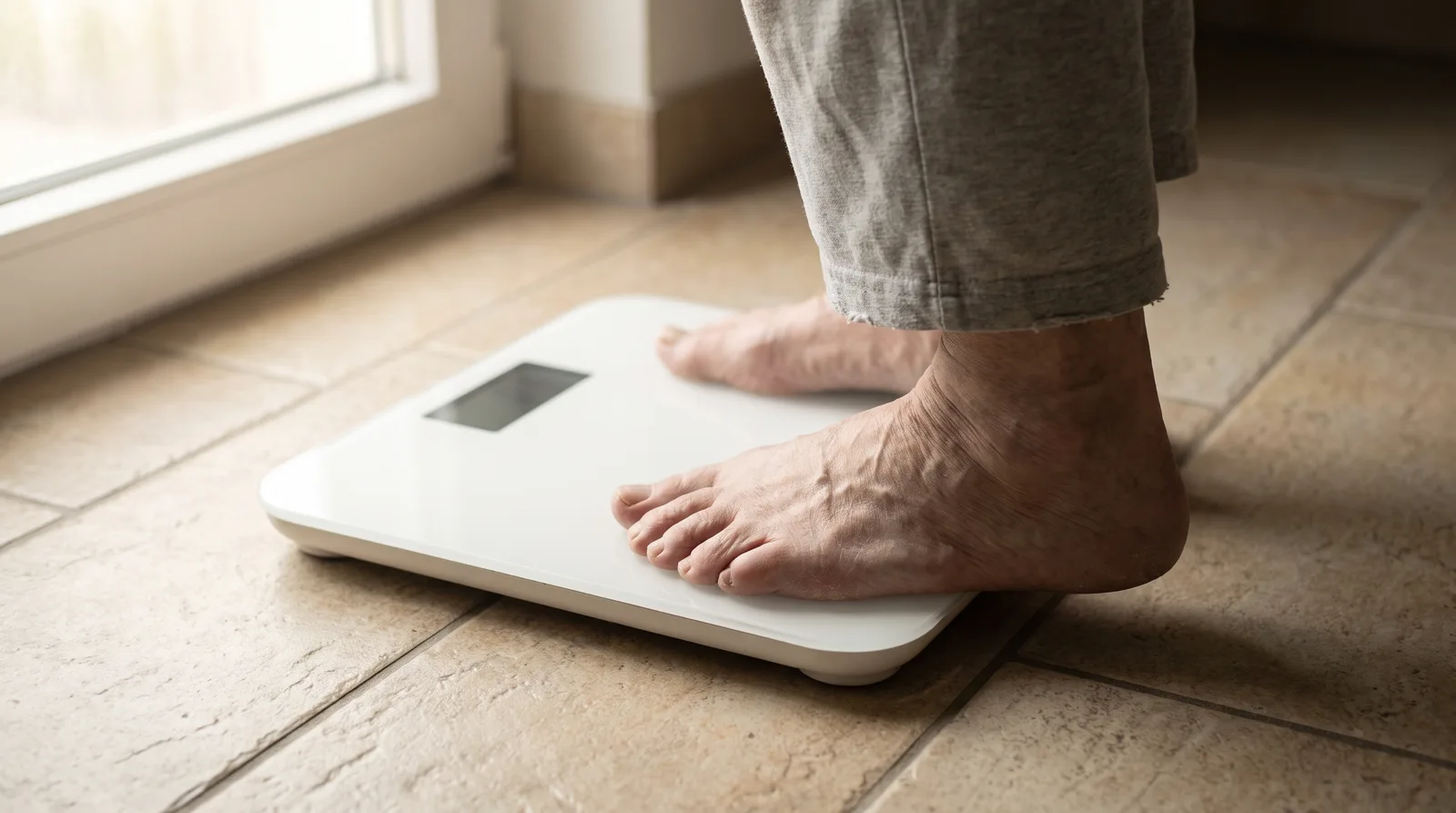
Two patients lose their back teeth in the same year. One drops eighteen pounds over three years and their doctor starts running cancer screens. The other gains twenty-two and gets told to cut carbohydrates. Neither of them mentions their teeth, and neither doctor asks.
Both outcomes trace back to the same cause. Losing the ability to chew does not have one predictable effect on body weight, it has two opposite ones, and which one you get depends on whether you respond to the limitation by eating less food or by eating easier food. This is one of the least discussed consequences of tooth loss, and it is the one most likely to be misattributed to something else entirely.
This post covers the evidence for both directions, what determines which one applies to you, and what restoring chewing function does and does not change.
Does losing teeth cause weight loss?
In older adults, yes, and the effect is large enough to matter clinically.
The strongest evidence comes from a three-year longitudinal study of 53,690 community-dwelling Japanese adults aged 65 and over, which tracked weight loss of more than 10 percent of body weight. That threshold is not vanity territory. Unintentional weight loss at that scale is an established marker of frailty and a predictor of poor outcomes.
Weight loss at that level occurred in 6.8 percent of participants with 0 to 19 remaining teeth, compared with 4.3 percent of those with 20 or more. After adjusting for confounders, having fewer teeth carried a meaningfully higher risk of clinically significant weight loss.
The part that matters for treatment decisions
The same study looked at what happened when those patients wore dental prostheses. The risk attached to tooth loss was substantially lower among prosthesis users, and the authors calculated that the prosthesis reduced the weight-loss risk by 37.3 percent.
That is one of the more concrete numbers in this entire subject area. It does not isolate implants specifically, and the prostheses studied were largely conventional, but it establishes the mechanism plainly. Restoring chewing function reduces the risk of the kind of weight loss that lands older patients in frailty.
Does losing teeth cause weight gain?
In other populations, also yes, and the mechanism is the substitution effect.
A study drawing on the Health, Aging and Body Composition cohort followed 903 older adults and looked at weight change of at least 5 percent over four years. It found no significant association between tooth loss and weight loss in that cohort, but it did find that weight gain was associated with fewer teeth, with fewer functional tooth units in the posterior region, and with fewer molar functional tooth units specifically. The authors flagged food choice as the likely mechanism needing further study.
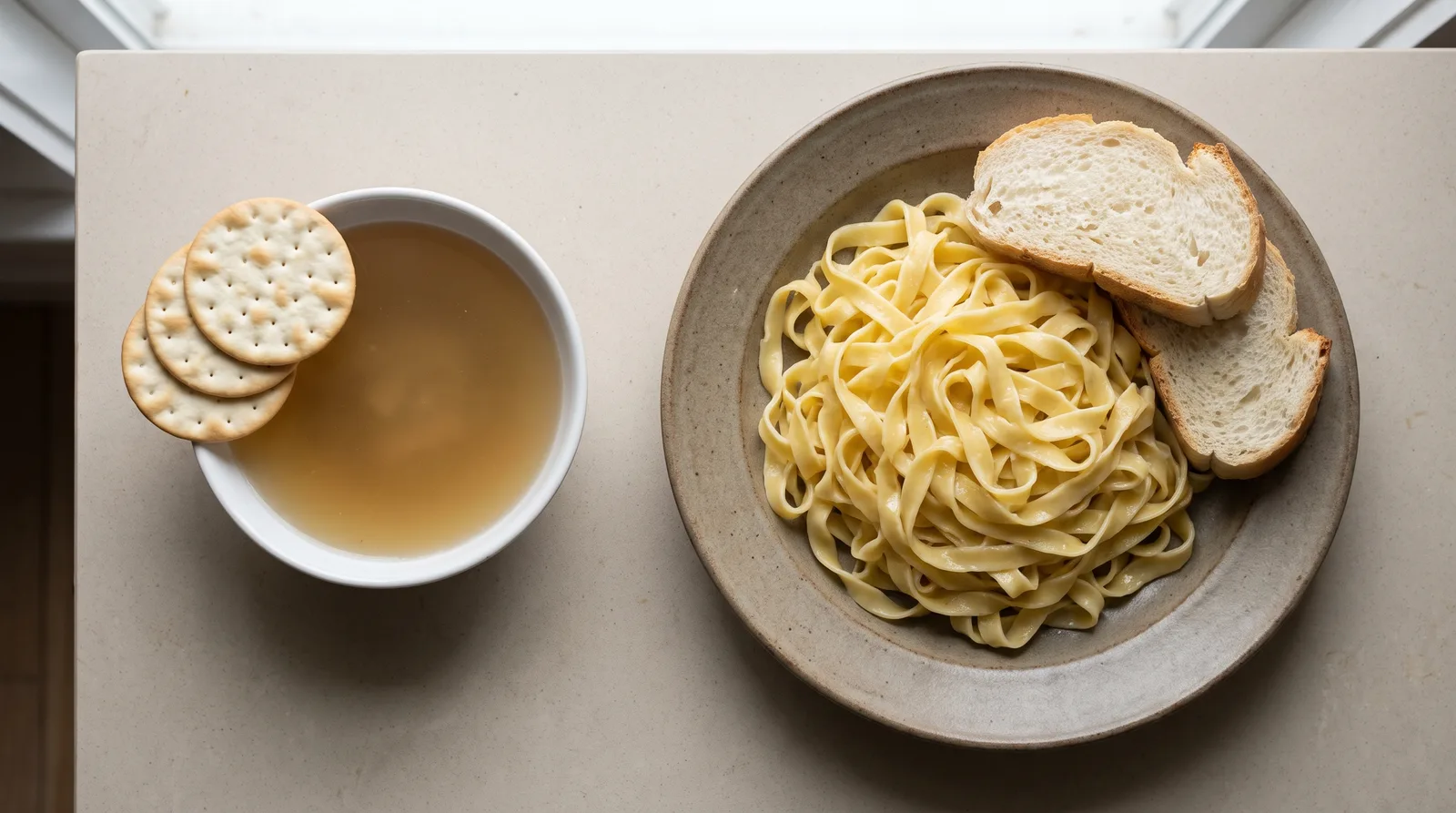
The logic is straightforward once you look at what replaces hard food. Steak, raw vegetables, whole fruit, and nuts are replaced by bread, pasta, mashed potatoes, soup, ice cream, and processed snacks. Every item on that second list is softer, more calorie-dense per unit of chewing effort, and less filling per calorie. A person eating that way is not overeating in any deliberate sense. They are eating the food their mouth permits, and that food happens to be the food that adds weight.
Why the two findings do not cancel out
It would be easy to look at one study showing weight loss and another showing weight gain and conclude the research is a mess. It is not. The populations differ in the way that determines the outcome.
Where appetite and access are already fragile, which describes a lot of adults over 75 living alone, a chewing limitation removes food from the plate and weight comes off. Where appetite is intact and convenient soft food is abundant, which describes most adults in their 50s and 60s, the same limitation shifts the composition of the plate and weight goes on.
The underlying event is identical. The direction depends on you.
Why does softer food leave you less satisfied?
Because chewing is part of how your body registers a meal, not just how it breaks one down.
Fullness is assembled from several signals. Stomach stretch is the obvious one. Less obvious are the signals that come from the act of eating itself: the time a meal takes, the number of chews, and the sensory exposure to flavor and texture along the way. Soft food shortens all of them. A meal that takes eight minutes generates less of this signalling than the same calories taken over twenty, which is why people who eat quickly tend to eat more before feeling finished.
Texture also changes how fast food is absorbed. Foods broken down into smaller particles, whether by chewing or by processing, empty from the stomach faster and are digested faster. With carbohydrates in particular, that produces a steeper rise in blood sugar and a faster return of hunger. A denture wearer eating mashed potato instead of a whole baked potato gets the same calories on a faster clock.
None of this makes soft food inherently bad. It makes a diet built entirely from soft food harder to feel satisfied on, which is the practical reason a chewing limitation nudges intake upward. It also explains something patients report after getting fixed implant teeth, which is that meals take longer and they feel finished sooner. That is not imagination. It is the chewing signalling coming back.
Which direction are you headed?
A few honest questions will tell you more than a scale will.
If you find yourself skipping meals because eating has become tiring, if you have quietly reduced portion sizes, or if food has become less enjoyable in a general way, you are on the weight-loss track. This is the more dangerous of the two and the one that warrants moving faster, because muscle mass lost after 70 is difficult to rebuild. Age itself is not a barrier to treatment, and the reasoning is set out in the guide to whether there is an age limit for dental implants.
If your meals have gotten softer and more carbohydrate-heavy, if you snack more than you used to, or if you finish meals still feeling unsatisfied, you are on the weight-gain track. Softer food clears the stomach faster and generates less of the chewing-related signalling that contributes to feeling full, so eating more is a predictable response rather than a failure of willpower.
If both descriptions sound partly true, the usual explanation is that you are eating fewer meals but denser ones, which produces a stable weight and a deteriorating diet. That is the hardest version to catch, and the one the nutritional consequences of tooth loss will show up in long before the scale does.
Will dental implants change your weight?
Here is where honesty matters more than the sales pitch, because the answer is not a simple yes.
A randomized trial of 60 edentulous adults aged 65 to 75 compared mandibular two-implant overdentures against conventional dentures and measured nutritional state before and six months after treatment. The implant group showed significant improvements in several body composition measures, including percent body fat, skin-fold thickness at the biceps, subscapularis and abdomen, waist circumference, and waist-hip ratio, along with increases in serum albumin, hemoglobin, and B12. The conventional denture group did not show those improvements.
The important caveat is in the same paper. No significant between-group differences were found. The implant group improved and the denture group did not, but the study was not large enough to prove the implants were the reason. The authors concluded that low-cost implant overdenture treatment may improve nutritional state, and "may" is doing real work in that sentence.
A larger randomized trial of 255 patients and a 2026 meta-analysis both found no consistent nutritional advantage for implant overdentures over conventional dentures on blood markers. What they did find was a significant difference in what patients could chew and in how much of their nutrition came from fresh whole fruits and vegetables.
So what should you actually expect?
Expect implants to remove the constraint. Do not expect them to manage your weight.
If you are underweight and losing, restoring chewing function makes a normal diet physically possible again, and the prosthesis data suggests that meaningfully reduces your risk of continued loss. That is a real clinical benefit and a reasonable thing to factor into the decision.
If you are overweight because your diet drifted soft and starchy, implants give you the ability to eat differently and nothing more. The weight will not come off because the hardware changed. It comes off if you use the restored function to rebuild the diet, and patients who pair treatment with even simple dietary guidance do better than patients who do not.

What should you tell your physician?
Two things, and neither takes long.
Tell them if you have had a change in what you are able to chew, and be specific about foods rather than about comfort. Unintentional weight loss triggers an expensive and stressful workup, and chewing ability belongs on the list of things ruled out early rather than discovered last.
Tell them if you are planning implant treatment, particularly if you take medication that needs food, manage diabetes, or are being monitored for frailty or sarcopenia. Treatment involves a soft-food period that can run several months for full-arch cases, and that period is a nutritional risk of its own for someone already underweight. Planning for it beforehand is straightforward. Discovering it afterward is not.
The Bottom Line
Tooth loss moves weight in both directions. In older adults it drives clinically significant weight loss, and prostheses cut that risk by roughly a third. In adults with intact appetite it drives weight gain, through a shift toward soft, calorie-dense food rather than through overeating. Implants reliably remove the physical constraint, and the evidence that they improve body composition on their own is suggestive rather than proven.
Work out which direction you are headed, tell your physician, and treat the diet as its own project rather than a side effect of the hardware. When you are ready to compare treatment options, find qualified providers near you at Dental Implant Directory.
Ready to find a qualified provider?
Search our independent directory of dental implant providers organized by specialty, location, and credentials.
Ready to find a qualified provider?
Search our independent directory of dental implant providers organized by specialty, location, and credentials.