
Most people considering dental implants have already done the cost math. What they have not done is the food math, and the food math is the part they will live with three times a day for the rest of their lives. A denture wearer who gave up steak, corn on the cob, apples, and nuts eight years ago has quietly rebuilt an entire diet around what the appliance allows. That diet is the real cost of the appliance, and nobody put it on the treatment plan.
The problem is that nobody gives you a straight answer about this. Denture marketing shows people eating salad. Implant marketing shows people eating steak. Both are selling, and neither tells you the part that matters, which is that chewing ability is not a yes or no question. It sits on a scale, the scale is measurable in newtons of bite force, and where you land on it depends on which of the four common solutions you choose.
This post puts real numbers on that scale and then walks through the foods that separate one tier from the next.
How much bite force do dentures, implants, and natural teeth actually produce?
Bite force is the cleanest way to compare, because it is measured the same way in every mouth. Healthy natural teeth generate roughly 150 to 300 newtons in the molar region. Conventional full dentures sit far below that, commonly in the 50 to 70 newton range. Implant-supported teeth land in between, closer to natural teeth than to dentures.
The landmark comparison came from the University of Nijmegen, where researchers measured bite force and chewing efficiency using identical methods across subjects with implant overdentures, conventional full dentures, and natural dentitions. Their finding was that bite forces with implant overdentures fell between those of artificial and natural dentitions, and chewing efficiency was significantly greater than that of full denture wearers with a low mandible.
That same study found something more useful for anyone weighing options. Across all groups combined, maximum bite force and chewing efficiency were significantly correlated, and nearly half the variation in chewing efficiency was explained by bite force alone. In plain terms, force is not a vanity number. It is roughly half of your actual ability to break food down.
Why the denture number is so low
A conventional upper denture is held in by suction against the palate. A conventional lower denture is held in by gravity and the cooperation of your tongue and cheeks, which is to say it is barely held in at all. Every newton you generate has to be generated without destabilizing an appliance that is only resting on tissue. Your own nervous system learns this and starts limiting your bite before you consciously decide to, which is why long-term denture wearers often say they have not so much given up steak as lost interest in it.
Implants change the mechanics. The force transfers into bone rather than into gum tissue, so there is nothing to dislodge and nothing to bruise. The limiter comes off.
What foods can you eat with implants that dentures make difficult?
The foods that separate the tiers are the ones that require either a hard initial bite, a sustained grinding motion, or both. Here is where the practical line falls.
Foods that require an incisal bite
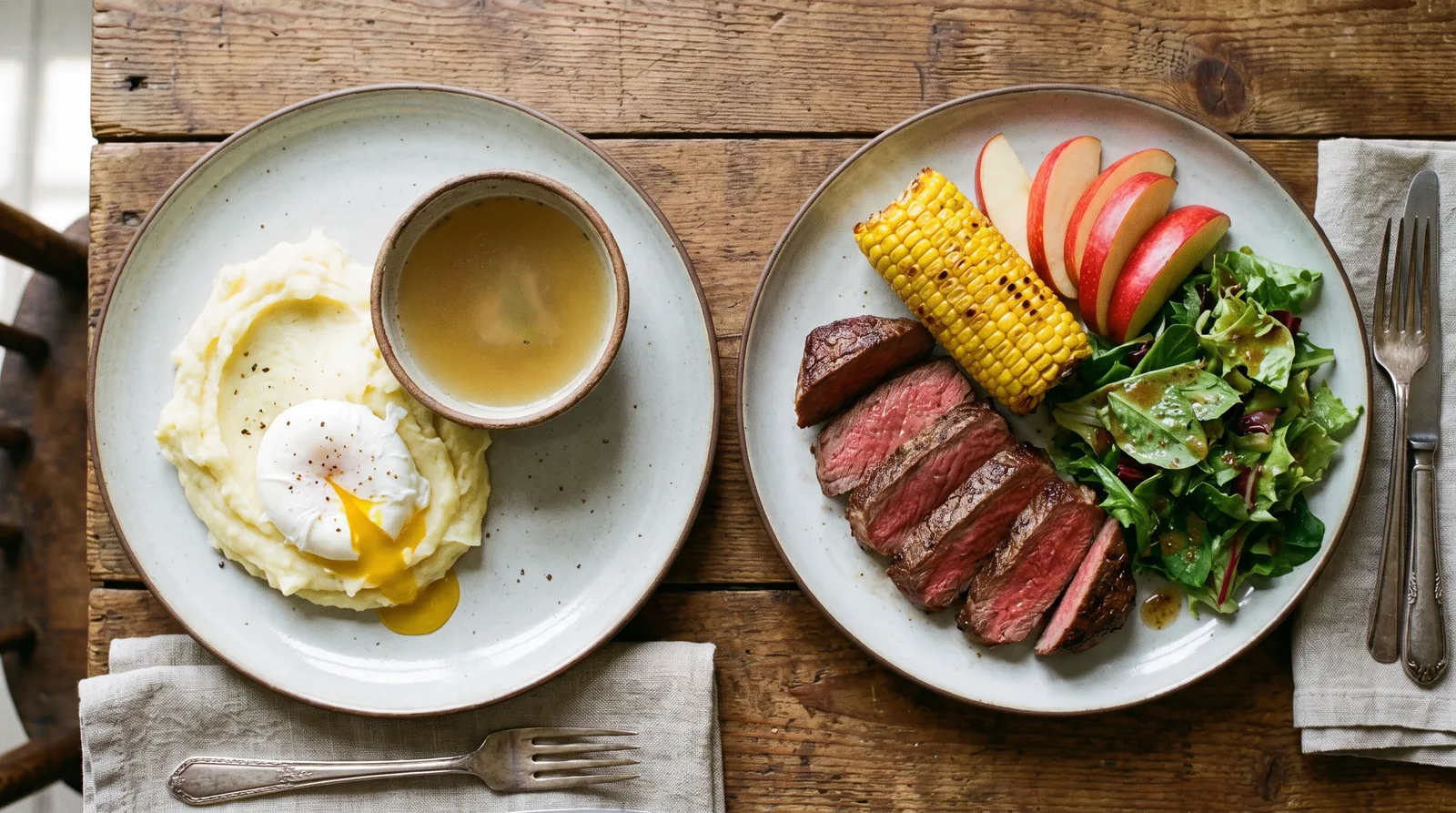
An incisal bite is the front-tooth tear: biting into a whole apple, corn on the cob, a firm sandwich, a carrot, a rack of ribs. This is the single hardest thing for an upper denture, because biting down at the front levers the back of the denture off the palate. Denture wearers learn to cut everything into pieces first, and a lot of them never eat corn on the cob again.
Fixed implant teeth restore this almost completely. Implant overdentures restore it partially, depending on how many implants and whether the upper is still a palate-covered denture.
Foods that require sustained grinding
Steak, well-done meat, crusty bread, bagels, raw vegetables, tough greens like kale, dried fruit, and jerky all require repeated high-force grinding rather than one hard bite. This is where the bite force number does most of its work. Denture wearers frequently switch to ground meat, slow-cooked meat, and canned vegetables, not because they prefer them but because those foods survive a 60 newton bite.
Foods that punish an unstable appliance
Nuts, seeds, popcorn, and small grains do not require much force at all. They cause trouble because fragments get under a denture and press into gum tissue, which hurts immediately and can keep hurting for days. This is a category where implants make a difference out of proportion to the force numbers, because the appliance no longer has an underside for food to get beneath. A fixed implant bridge has a cleanable gap underneath by design, but it is not pressing on tissue, so a seed there is a hygiene task and not a source of pain.
Foods that were never the problem
Fish, eggs, pasta, rice, bananas, cooked vegetables, soups, and soft cheeses are all manageable with a well-made conventional denture. If your diet already runs this way by preference, the eating argument for implants is weaker for you than it is for someone who misses steak, and you should weigh the cost on other grounds. An honest provider will say this.
Which implant option gives back the most chewing ability?
There are four common tiers, and they are not close to equivalent.
A conventional full denture is the baseline. Nothing is anchored, the upper covers the palate, and the lower floats. This is the 50 to 70 newton tier.
An implant overdenture with two implants, usually in the lower jaw, is the most common upgrade and the one with the most research behind it. It snaps onto two anchors and stops moving. Chewing efficiency improves substantially over a conventional lower denture, and the appliance still comes out at night. If you are weighing this option, the full mechanics are covered in the guide to implant-supported dentures.
An implant overdenture with four or more implants and a bar is more stable again and, in the upper jaw, often allows the palate to be removed. That last detail matters more than patients expect, because the palate is where most of your taste and temperature sensation lives.
A fixed full-arch bridge, which is what All-on-4 delivers, is screwed in and never comes out. This is the tier that gets closest to natural chewing, and it is the tier where patients describe eating without thinking about eating.
What "90% of natural function" really means
You will see providers claim implants restore up to 90 percent of natural chewing function. That figure is not invented, but it describes fixed implant teeth in a healthy patient and it is an upper bound rather than an average. Even at the top tier, implants lack the periodontal ligament that surrounds a natural tooth root, and that ligament carries the mechanoreceptors that let you sense a cherry pit or a shard of bone before you bite through it. Implant patients bite harder with less fine feedback, which is exactly why a hard olive pit sends some of them back to the office with a chipped tooth.
Treat 90 percent as a ceiling, treat the sensory difference as permanent, and treat any provider who says you will not notice a difference as someone who is selling.
What actually changes at the grocery store?
The research that best answers this came from a randomized trial of 255 edentate patients over 65, half given mandibular implant overdentures and half given new conventional dentures. At six and twelve months, blood markers of nutritional status did not differ meaningfully between the groups. What did differ, significantly, was food preparation and the ability to chew a variety of foods, and the implant group was significantly more likely to take in their nutrients through fresh, whole fruits and vegetables.
That is the finding to hold onto, because it is the honest one. Implants did not make anyone's bloodwork better within a year. They changed what people could put in the cart and how much of it had to be cooked down, pureed, or bought pre-cut. Over years, that is the thing that compounds.

What foods should you still be careful with after implants?
Implants are titanium in bone, but the teeth on top are ceramic, zirconia, or acrylic, and those can chip. The permanent caution list is short and it is about hardness, not toughness.
Ice is the first item, and it is the one that breaks the most restorations. Hard candy is the second. Olive pits, cherry pits, unpopped popcorn kernels, and bone fragments are the third, and they cause damage because you cannot feel them coming. Nuts are fine for most fixed implant patients and a judgment call for overdenture patients.
Sticky foods are a separate category. Caramel and taffy will not hurt an implant, but they can pull at a cemented crown and they are difficult to clear out from under a fixed bridge, which matters for the gum health that keeps implants in the bone long-term.
Acrylic teeth on a temporary All-on-4 bridge are the most fragile thing in this whole discussion, which is why the temporary phase has its own rules and why patients who ignore them end up back in the chair.
The Bottom Line
Bite force tells you most of what you need to know. Conventional dentures give you roughly a quarter to a third of natural force, implant overdentures land in the middle, and fixed implant teeth get closest to natural, with the permanent caveat that you lose the fine pressure sensing a natural root provides. The foods that separate the tiers are the ones requiring a front-tooth bite or sustained grinding, which means apples, corn, steak, crusty bread, and raw vegetables. The best evidence says implants change what you are able to chew and how you shop long before they change anything measurable in your blood, and that is still a reason worth spending money on.
Before you commit to a tier, ask the provider to name the bite force and food expectations for the specific plan they are proposing, not for implants in general. And when you are ready, find qualified providers near you at Dental Implant Directory.
Ready to find a qualified provider?
Search our independent directory of dental implant providers organized by specialty, location, and credentials.
Ready to find a qualified provider?
Search our independent directory of dental implant providers organized by specialty, location, and credentials.