
Patients who have lost teeth often describe the same set of complaints, and they rarely connect them to their mouth. Meals sit heavily. Certain foods cause bloating that they did not used to cause. They feel hungry again sooner than the size of the meal should allow. A physician looking at this list reasonably thinks about the stomach, and the answer is sometimes a few inches higher up.
Chewing is not a preliminary to digestion. It is the first mechanical stage of it, and it is the only stage you have conscious control over. When that stage is compromised, everything downstream has to compensate, and the compensation is imperfect.
This post explains what chewing actually does, what happens when it is reduced, and which of the common claims about this are real and which are exaggerated.
What does chewing actually do to food?
Three things, and they happen at the same time.
The first is particle reduction. Chewing breaks food into smaller pieces, which increases the total surface area that digestive enzymes can work on. A well-chewed mouthful of almonds presents dramatically more surface to the gut than a poorly chewed one, and studies on nuts in particular have shown that inadequate chewing leaves more fat and nutrient locked inside intact cell walls, which then passes through without being absorbed.
The second is mixing with saliva. Saliva contains amylase, which begins starch digestion in the mouth, and lipase, which begins fat digestion. It also lubricates, which is what allows a bolus to be swallowed safely rather than scraped down.
The third is signalling. The act of chewing tells the rest of the digestive system that food is coming. Gastric secretions, pancreatic enzymes, and the hormonal responses that govern fullness all begin before food reaches the stomach, triggered partly by chewing and tasting. Reduce the chewing and you soften that starting gun.
What a bolus is supposed to look like
A swallow-ready bolus is cohesive, lubricated, and reduced to particles small enough to move safely through the pharynx. Healthy dentition achieves this in roughly 15 to 25 chews for most foods. A full denture wearer often needs two to three times as many chews to reach the same particle size, and many do not get there. They compensate by swallowing earlier, with a coarser bolus and more liquid.
That compensation is the actual mechanism behind most of the digestive complaints that follow.
How many teeth do you need to chew properly?
Fewer than a full set, and more than most people assume.
Dentists measure this in functional tooth units, which count pairs of opposing teeth that actually meet and grind against each other. A molar sitting alone with nothing above it is not a functional unit and contributes almost nothing to chewing. This is why two patients with the same number of remaining teeth can have very different chewing ability, and why counting teeth is a poor proxy for counting function.
The widely used benchmark is the shortened dental arch, which holds that around 20 well-distributed teeth with roughly four posterior occluding pairs is enough for acceptable function in most adults. Research supports the general shape of this. Subjects with a shortened dental arch generated bite forces similar to those with a complete natural dentition, although their chewing efficiency was still limited by the reduced grinding area available.
The threshold matters because it tells you where the cliff is. Losing a front tooth is a cosmetic and speech problem far more than a chewing one. Losing posterior units is where chewing capacity actually falls away, which is why the studies linking tooth loss to weight change find the association concentrated in molars and posterior functional units rather than in total tooth count.
It also tells you something practical about treatment planning. Replacing the teeth you lost first is not always the right order. Replacing the ones that restore opposing pairs at the back of the mouth usually does more for chewing per dollar spent, and a provider planning around function rather than around appearance will say so.
What happens when you swallow food that is not chewed enough?
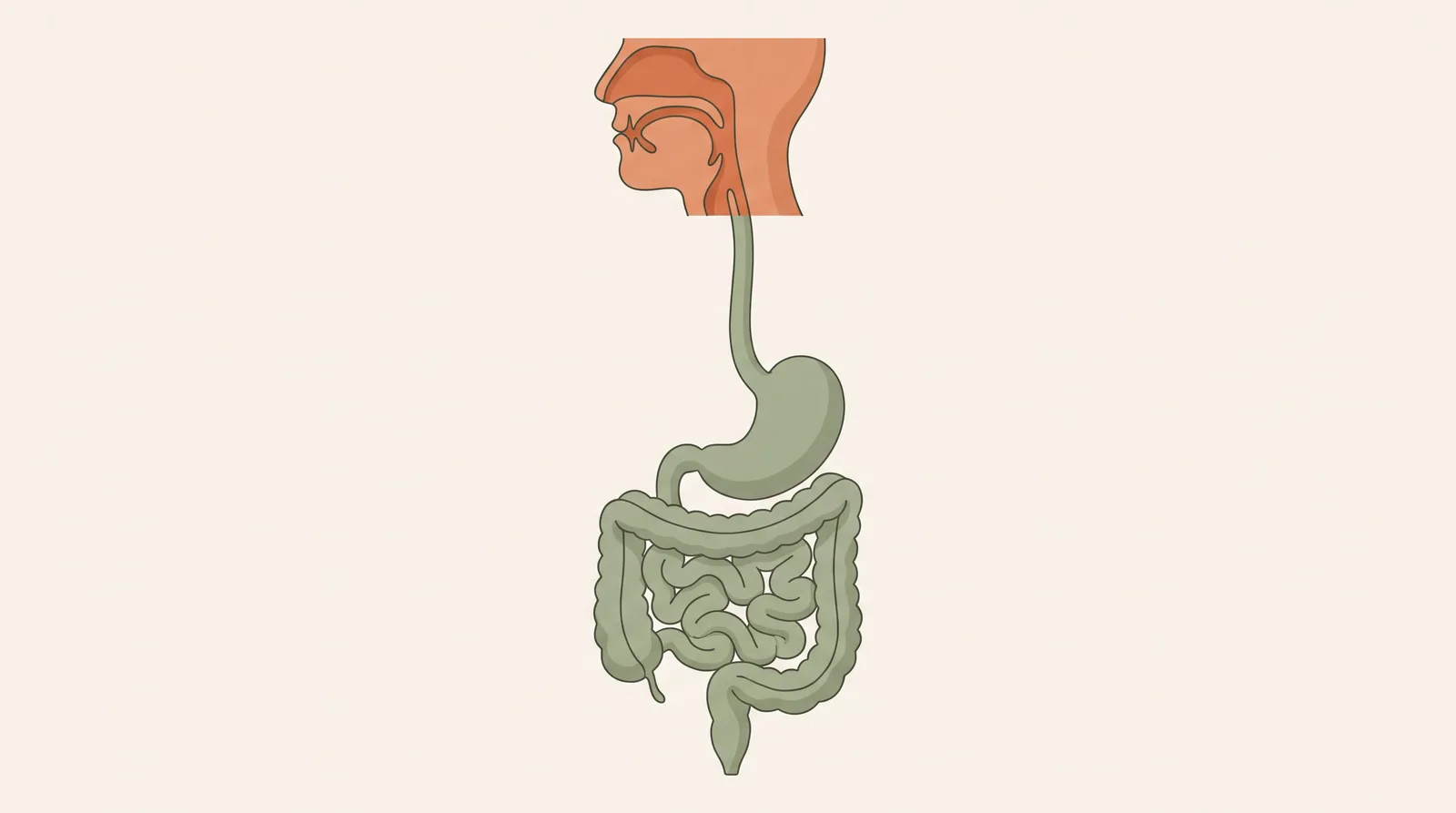
Larger particles take longer to break down in the stomach, which slows gastric emptying and produces the sensation of a meal sitting heavily. Food that reaches the large intestine incompletely digested gets fermented by gut bacteria instead, which produces gas and the bloating that follows.
Nutrient absorption drops for the foods most dependent on mechanical breakdown. Nuts and seeds are the clearest example, followed by raw vegetables and legumes, all of which have structures that resist enzymes until the cell walls are physically broken. This is one reason the nutritional gap in denture wearers is wider than their food diaries alone suggest. They eat less of these foods, and they absorb less of what they do eat.
Swallowing safety also matters more than most patients realize. A coarse bolus is harder to swallow cleanly, and in older adults that raises the risk of aspiration, where food or liquid enters the airway. This is one of the quiet reasons chewing ability appears in research on outcomes that seem unrelated to teeth.
Which claims about chewing and digestion are overstated?
Plenty, and it is worth separating them out, because this topic attracts a lot of wellness folklore.
The claim that you must chew every mouthful a specific number of times, usually 32, has no clinical basis. The number that matters is whether the bolus is ready, and that varies enormously by food. Yogurt needs none. A raw carrot needs many.
The claim that poor chewing causes acid reflux is oversimplified. Reflux is driven primarily by the lower esophageal sphincter, body weight, and meal composition. Eating quickly and in large volumes can aggravate it, and poor chewing tends to accompany both, but the teeth are not the cause.
The claim that implants will resolve a diagnosed digestive condition is not supportable. If you have irritable bowel syndrome, celiac disease, or gastroparesis, restoring chewing function may make eating more comfortable, and it will not treat the condition. Any provider who implies otherwise is selling outside their lane.
The defensible claim is narrower and still worth something. Restoring chewing restores the first mechanical stage of digestion, improves the completeness of nutrient extraction from hard foods, and makes a wider range of food practical to eat. That is the honest case.
Does restoring chewing function reverse the effects?
Mechanically, largely yes. Nutritionally, only if the diet follows.
Chewing efficiency improves measurably with implant-supported teeth. Research comparing implant overdentures, conventional dentures, and natural dentitions found chewing efficiency with implant overdentures was significantly greater than in full denture wearers with a resorbed lower jaw, and that bite force explained nearly half of the variation in chewing efficiency across all groups. Fixed full-arch implant teeth do better still. The machinery works again.
Whether that translates into better nutritional status is a separate question, and the evidence is mixed. A randomized trial of 255 edentate adults over 65 found no significant advantage for implant overdentures over new conventional dentures on blood markers at six and twelve months, though the implant group was significantly more likely to get their nutrients from fresh, whole fruits and vegetables. A 2026 meta-analysis reached a similar conclusion.
The reading that fits both findings is this. Implants fix the mechanism. The diet is a habit, and habits need their own intervention. If digestion or nutrition is part of why you are considering treatment, say so at the consultation, because it should change what the provider recommends and what happens after the case is delivered. The broader picture of what tooth loss does to nutrition is worth reading before that appointment.

What can you do before and during treatment?
If you are chewing on a compromised dentition right now, a few adjustments genuinely help.
Cut food smaller before it reaches your mouth. This is not a defeat, it is doing mechanically what your teeth are struggling to do, and it improves both absorption and swallowing safety.
Cook hard vegetables rather than dropping them. Steaming or roasting a carrot softens the cell walls without removing much of the nutrient content, and it keeps beta carotene in the diet when a raw carrot is off the table.
Blend rather than juice. Blending keeps fiber in the drink, juicing removes it, and fiber is the nutrient tooth loss takes first.
Choose ground or slow-cooked meat over giving up meat. Protein intake is the one thing an older adult can least afford to lose, and the form matters far less than the amount.
Expect a soft-food period during treatment. Full-arch cases run months on a temporary prosthesis with real dietary restrictions, and the week-by-week recovery guide sets out what that period actually looks like.
The Bottom Line
Chewing does three jobs: it reduces particle size so enzymes can work, it mixes food with saliva, and it signals the rest of the digestive system that food is arriving. Losing it means swallowing a coarser bolus, extracting less from hard foods, and feeling meals sit heavily. Implants restore the mechanism, with chewing efficiency measurably better than conventional dentures, but they do not treat digestive conditions and they do not by themselves fix a diet built around the limitation.
Be skeptical of anyone claiming implants will solve a gut problem, and be equally skeptical of anyone who tells you chewing does not matter. When you are ready to talk to a provider, find qualified providers near you at Dental Implant Directory.
Ready to find a qualified provider?
Search our independent directory of dental implant providers organized by specialty, location, and credentials.
Ready to find a qualified provider?
Search our independent directory of dental implant providers organized by specialty, location, and credentials.