If you are researching All-on-4, you are probably facing one of the harder decisions in dentistry: what to do when most or all of your teeth are failing. The stakes are real. This is a surgical procedure, a five-figure investment, and a set of teeth you will live with for decades. Getting it right the first time matters, because redoing full-mouth work is far more expensive and complicated than doing it well once.
The problem is that most of what you will read about All-on-4 is written by practices trying to sell it to you. Ads compress the whole thing into "new teeth in a day" and a starting price that rarely survives the consultation. What is missing is a plain explanation of what the technique actually is, who it works for, and what the process looks like week by week.
This guide covers exactly that: the mechanics, the candidacy requirements, the procedure, the timeline, the costs, and how All-on-4 compares to your other options.
What is the All-on-4 dental implant technique?
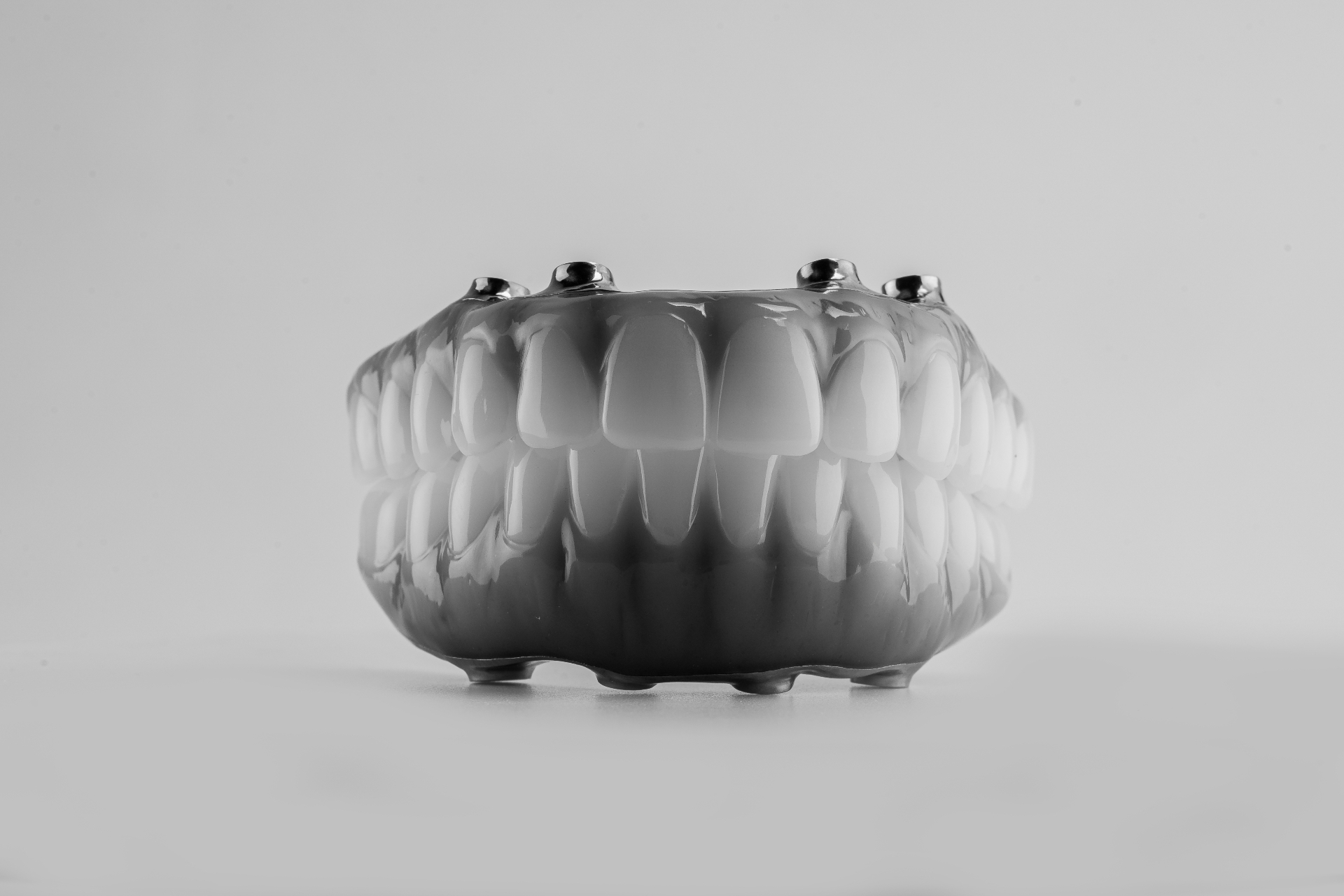
All-on-4 is a full mouth replacement method. Your remaining teeth are removed, and each jaw receives a fixed bridge of 12 to 14 prosthetic teeth anchored on four dental implants. Treating both the upper and lower arches replaces every tooth in your mouth with teeth that stay in permanently, unlike dentures, which rest on the gums and come out.
The name describes the engineering: all of the teeth in an arch, supported on four implants. The two front implants go in vertically, like standard implants. The two back implants are placed at an angle of up to 45 degrees. That tilt is the core innovation. It lets the implants anchor in the denser bone toward the front of the jaw and avoid anatomical obstacles like the sinus cavities in the upper jaw and the nerve canal in the lower jaw.
The technique was developed in the 1990s by Dr. Paulo Malo working with Nobel Biocare, and it has since become the most widely used protocol for full-arch restoration, with hundreds of thousands of cases and more than two decades of published clinical data behind it.
Why does All-on-4 use only four implants per arch?
Because four well-positioned implants can do the structural work of many more, at lower cost and with less surgery. Replacing a full arch tooth by tooth would require eight to ten implants and, in most patients, significant bone grafting to support the ones toward the back of the jaw.
The angled rear implants solve two problems at once. First, they increase the length of implant that contacts bone, which improves stability. Second, they let the surgeon work around areas where bone has already shrunk. When teeth have been missing or failing for years, the bone in the back of the jaw is usually the first to deteriorate. By tilting the implants forward into stronger bone, most patients can skip the bone grafts and sinus lifts that would otherwise add months and thousands of dollars to treatment.
Fewer implants also means a shorter surgery, a simpler recovery, and fewer components that can develop problems over the life of the restoration.
Who is a good candidate for All-on-4?
The typical All-on-4 candidate has lost most of their teeth, is about to lose them, or is struggling with dentures. If you have widespread decay, advanced gum disease that has loosened multiple teeth, or a denture that no longer fits because the bone underneath has shrunk, you fit the profile this technique was designed for.
Health matters more than age. Patients in their seventies and eighties get All-on-4 successfully. What surgeons screen for is healing capacity: controlled blood sugar if you are diabetic, no active untreated gum infection at the time of surgery, and enough bone in the front of each jaw to anchor the implants. Smoking is the single biggest controllable risk factor, and many surgeons require patients to quit for a window before and after surgery because smokers experience implant failure at roughly double the rate of non-smokers.
There are also people who should not choose All-on-4. If most of your teeth are healthy or restorable, removing them for a full-arch case is irreversible overtreatment, and a practice that recommends it deserves a second opinion. And if your upper jaw bone loss is severe enough that even angled implants cannot find anchorage, you may need zygomatic implants, which anchor in the cheekbone instead.
For a detailed breakdown of the screening criteria, see the All-on-4 candidate guide.
What happens during the All-on-4 procedure?
The process runs in three phases: planning, surgery day, and the healing period that ends with your permanent teeth.
Planning and diagnostics
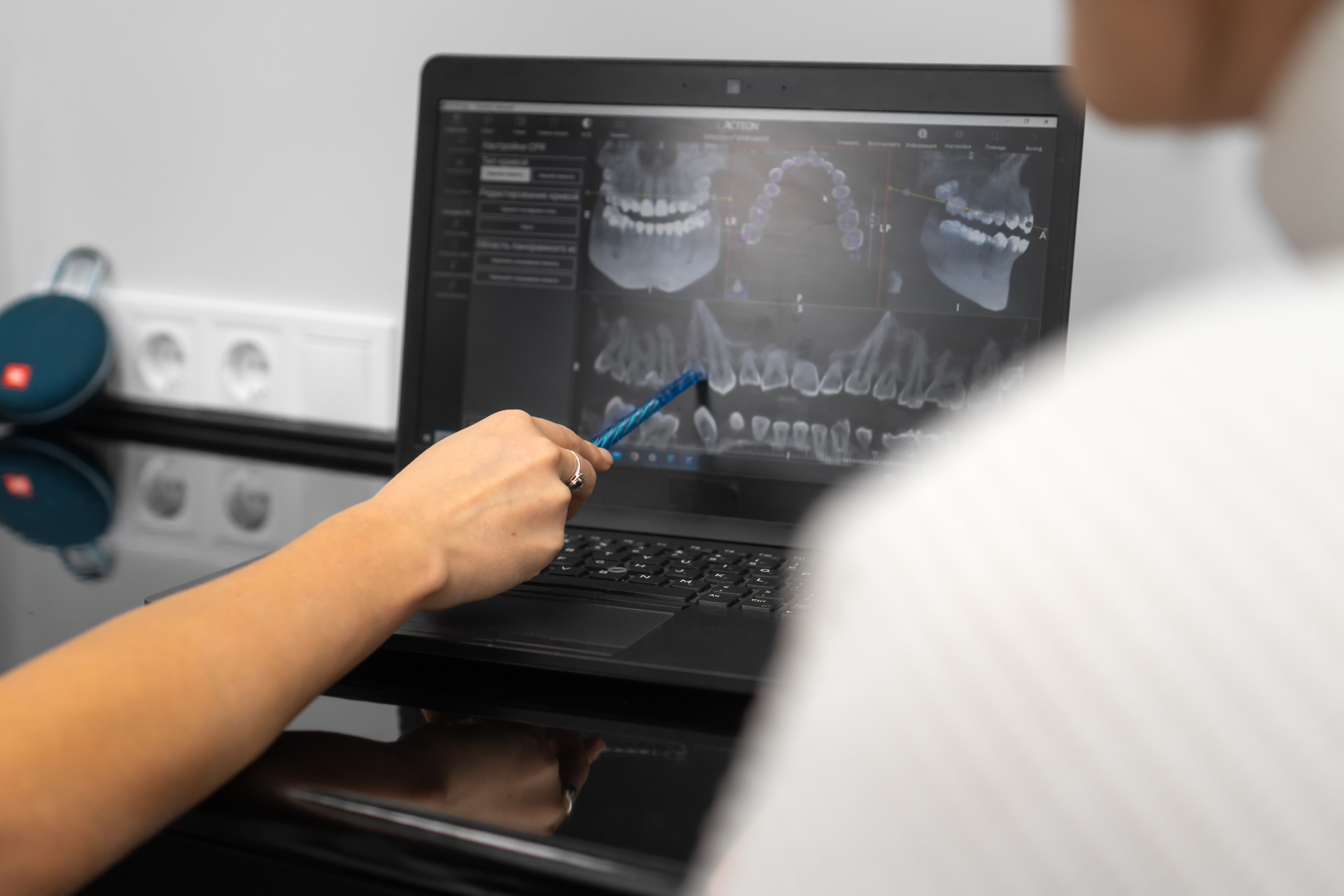
Every legitimate All-on-4 case starts with a 3D CBCT scan. This cone-beam CT image shows your bone volume, nerve positions, and sinus anatomy, and it is what the surgeon uses to plan exactly where each implant will go. Many practices now design the case digitally and fabricate surgical guides before you ever sit in the chair. A practice that quotes you a full-arch price without a CBCT scan is guessing, and that is a reason to keep looking.
Surgery day
The surgery itself typically takes about two hours per arch and is usually done under IV sedation. The surgeon removes any remaining failing teeth, reshapes the bone ridge where needed, and places the four implants in their planned positions. Before you leave, a temporary fixed bridge is attached to the implants. This is the "teeth in a day" part of the marketing, and it is real: you walk out the same day with a full set of non-removable teeth.
What the ads skip is that these are temporary teeth, made of acrylic and designed for the healing period, not for the next decade. You will eat a soft diet while the implants fuse with the bone, because heavy chewing forces during those first months can compromise the fusion.
Healing and the permanent bridge
Over the next three to six months, the implants integrate with your jawbone through a process called osseointegration. Once your surgeon confirms the implants are solid, the temporary bridge is replaced with your permanent one, custom made from either acrylic on a titanium frame or zirconia. That permanent set is what you will actually live with, and it is worth confirming up front whether it is included in your quoted price, because many advertised prices cover only the temporary.
Recovery is more manageable than most patients expect. Swelling and bruising peak around day three and fade over the first two weeks, and most people return to work within a few days to a week. The All-on-4 recovery guide walks through the healing process stage by stage.
How much does All-on-4 cost?
In 2026, realistic US pricing runs $15,000 to $25,000 per arch for an acrylic hybrid bridge and $25,000 to $38,000 per arch for zirconia. Since All-on-4 is a full mouth treatment priced per arch, a complete case typically lands between $30,000 and $50,000 with acrylic, and $50,000 or more with zirconia. High-cost markets run higher still. In California, full mouth All-on-4 frequently reaches $40,000 to $60,000 or more.
The number to ignore is the headline price in the ad. Quotes like "$9,995 per arch" typically exclude extractions, the CBCT scan, sedation, and sometimes the permanent bridge itself. The only number that matters is the all-inclusive price, in writing, from consultation through final teeth. The full All-on-4 cost breakdown covers what drives quotes up or down and the six questions that make competing quotes comparable.
How does All-on-4 compare to dentures and individual implants?
Against traditional dentures, the differences are structural. Dentures rest on your gums, move when you eat, limit you to roughly a quarter of natural bite force, and accelerate bone loss because the jaw has no tooth roots stimulating it. All-on-4 teeth are fixed to implants, restore most of your natural chewing power, and the implants themselves slow further bone loss. Dentures win on upfront cost, and for some patients that is decisive. The implants versus dentures comparison goes deeper on that tradeoff.
Against individual implants for every tooth, All-on-4 wins on cost, surgery time, and grafting avoidance. Replacing a full arch tooth by tooth can run $30,000 to $60,000 or more per arch and usually requires grafting. The tradeoff is that All-on-4 is a bridge: the teeth come as a connected unit, and if a segment is damaged, the prosthesis is repaired or replaced as a unit rather than as a single tooth.
How long do All-on-4 implants last?
The implants themselves are designed to be permanent, and published studies consistently show success rates of 95 to 98 percent at the 10 year mark. The prosthetic bridge is a wear item. Acrylic hybrid bridges typically need refurbishment or replacement around 10 to 15 years. Zirconia lasts longer and resists staining and fracture, which is a large part of why it costs more up front.
Longevity depends heavily on maintenance. Implants cannot get cavities, but the gum and bone around them can develop peri-implantitis, an infection that is the leading cause of late implant failure. Daily cleaning under the bridge and regular professional maintenance visits are what protect the investment. If you grind your teeth, expect your provider to recommend a night guard.

How do you choose the right All-on-4 provider?
Provider selection is the highest-leverage decision in the entire process, because the biggest failure factors, case selection and surgical planning, are set before the first incision. Full-arch surgery is not a procedure to learn on, so case volume matters. Ask any prospective surgeon these questions:
- How many full-arch cases have you completed, and how many do you do per month?
- Who places the implants and who makes the prosthesis, and are both under one roof?
- Is the CBCT scan, sedation, and my permanent bridge included in the quoted price?
- What material is the final bridge, acrylic hybrid or zirconia?
- What is your protocol if an implant fails to integrate, and what does the warranty cover in writing?
Specialists such as oral surgeons, periodontists, and prosthodontists typically charge more than general dentists, but for full-arch work that experience usually translates into fewer complications over the life of the restoration. The provider selection checklist covers credentials and red flags in detail.
The Bottom Line
All-on-4 replaces a full mouth of failing teeth with fixed bridges anchored on four implants per jaw, and its angled-implant design lets most patients skip bone grafting and leave surgery with teeth the same day. It is proven, with 95 to 98 percent long-term success, but the outcome depends on honest candidacy screening, a written all-inclusive price, and a surgeon with real full-arch volume. Take the time to compare providers on credentials rather than advertising. And when you are ready, find qualified providers near you at Dental Implant Directory.
Ready to find a qualified provider?
Search our independent directory of dental implant providers organized by specialty, location, and credentials.