Two consultations, two plans, two prices. One provider says four implants will hold your new arch for the rest of your life. The other says four is cutting corners and you need six. Both sound confident, and the difference on the quote is several thousand dollars per arch. Choosing wrong in one direction means paying for surgery you did not need. Choosing wrong in the other means a bridge that is under-supported in the exact spot where your bone is weakest.
The frustrating part is that neither provider is lying. All-on-4 and All-on-6 are both legitimate ways to restore a full arch, and the right number of implants depends on your bone, your bite, your habits, and which arch is being treated. What is missing from most consultations is an explanation of why the number was chosen for you, rather than why it is the number that practice always uses.
This guide explains what each implant count actually does, when the extra two implants earn their cost, and the questions that force a provider to justify the plan.
What is the difference between All-on-4 and All-on-6?
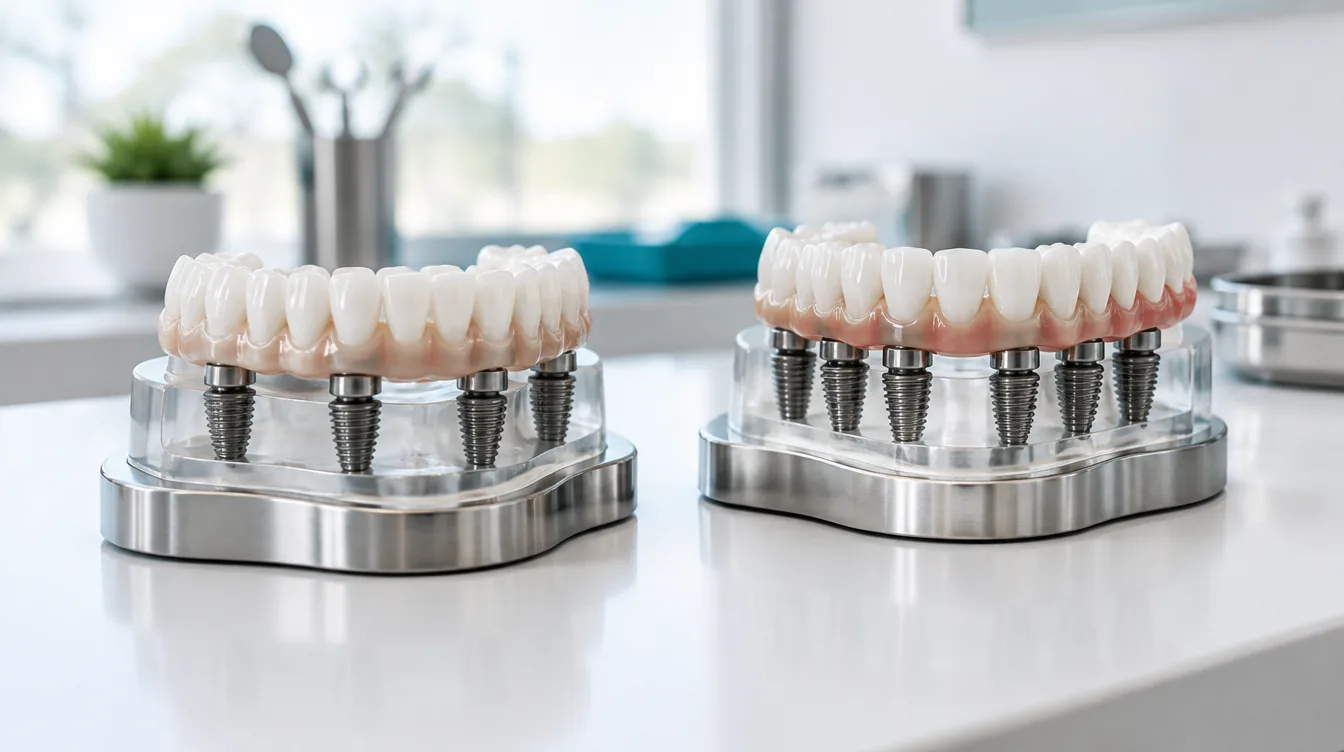
The difference is two implants per arch and where they sit. All-on-4 supports a full fixed bridge on four implants: two placed straight in the front of the jaw and two tilted at the back to reach denser bone and avoid the sinus in the upper jaw or the nerve canal in the lower jaw. All-on-6 adds two more implants, usually in the premolar or molar region, so the bridge rests on six points of support spread further back along the arch.
The bridge itself is the same kind of prosthesis in both cases: a full row of teeth on a frame that screws onto the implants and does not come out. The patient experience, the surgery day, and the healing timeline are close to identical. If you have read the complete guide to All-on-4, nearly everything in it applies to All-on-6 as well.
The engineering difference is load distribution. With four implants, the bridge has a cantilever, meaning the last one or two teeth on each side extend past the rear implant with no support underneath. Six implants shorten or eliminate that cantilever, which reduces the leverage on the rear implants every time you bite down on a molar.
Why four implants works at all
All-on-4 was developed specifically for patients who had lost bone in the back of the jaw and were told they needed grafting before implants were possible. Tilting the rear implants up to 45 degrees lets a longer implant anchor in the front of the jaw, where bone is usually thicker, while still emerging far enough back to support the bridge. The technique has been in use since the late 1990s, and long-term studies of the tilted-implant approach report implant survival rates above 90 percent at ten years. Four is not a compromise number. It is the number the technique was designed around.
What the extra two implants add
Six implants spread chewing force across more bone, which matters most in the upper jaw, where bone is naturally softer than the lower jaw. They also provide a margin of safety: if one implant fails to integrate or is lost years later, a six-implant bridge can often stay in place while the site is repaired. With four, losing one implant usually means the bridge has to come off until a replacement implant heals.
Who actually needs All-on-6 instead of All-on-4?
You are more likely to need six implants if you are restoring the upper jaw, if you have enough bone in the back of the jaw to place them without grafting, if you grind or clench your teeth, or if your bite is strong enough that the provider is worried about the cantilever. Four is usually the right number for the lower jaw, for patients with limited posterior bone, and for patients whose priorities are fewer surgical sites and lower cost.
The upper jaw case for six
The upper jaw loses bone faster after tooth loss and has a lower bone density to begin with. The sinus also sits directly above the back teeth, which limits how far back an implant can go without a sinus lift. Many surgeons prefer six implants on top when the bone allows it, because the softer bone benefits from more points of support and because the upper bridge carries the visible smile, where a failure is harder to hide.
The lower jaw case for four
The lower jaw is denser, and the tilted rear implants in an All-on-4 plan can anchor into very solid bone in front of the nerve canal. Four implants in the lower jaw have one of the strongest track records in implant dentistry. Some providers still place six on the bottom, but the clinical argument for it is weaker than on top unless the patient has an unusually heavy bite.
Grinders and clenchers
If you wear a night guard, have flattened teeth, or wake up with jaw soreness, tell every provider you consult. Bruxism puts repeated heavy force on a bridge and its implants, and it is the single most common reason a surgeon will recommend six implants and a zirconia bridge over four implants and acrylic.
When bone loss decides for you
Sometimes the choice is not a choice. If you do not have enough bone in the back of the jaw to place two more implants, All-on-6 would require bone grafting or sinus lifts first, adding months and thousands of dollars. In that case All-on-4 is not the cheaper option so much as the option that fits your anatomy. If bone loss is severe even in the front, your provider may discuss zygomatic implants, which anchor in the cheekbone. The guide to zygomatic dental implants covers who needs them.
How much more does All-on-6 cost than All-on-4?
Expect All-on-6 to cost roughly $3,000 to $8,000 more per arch than All-on-4 at the same practice with the same bridge material. The extra cost covers two additional implant fixtures, two more abutments, longer surgery time, and sometimes a heavier bridge frame. If grafting or a sinus lift is required to make room for the extra implants, the gap widens by several thousand dollars more.
That range sits on top of the base All-on-4 price, which in 2026 typically runs from the mid teens to the high twenties of thousands per arch for an acrylic bridge and more for zirconia. The All-on-4 cost breakdown explains what a complete quote should include and why advertised prices are almost always lower than the final bill.
Why some practices quote the same price for both
A few high-volume full-arch centers quote one price per arch regardless of implant count, because they treat the implant number as a clinical decision rather than a line item. This is a good sign when the surgeon explains the count in terms of your scan. It is a worse sign when the same practice always places four, or always places six, regardless of the patient in the chair.
Is All-on-6 worth the extra cost?
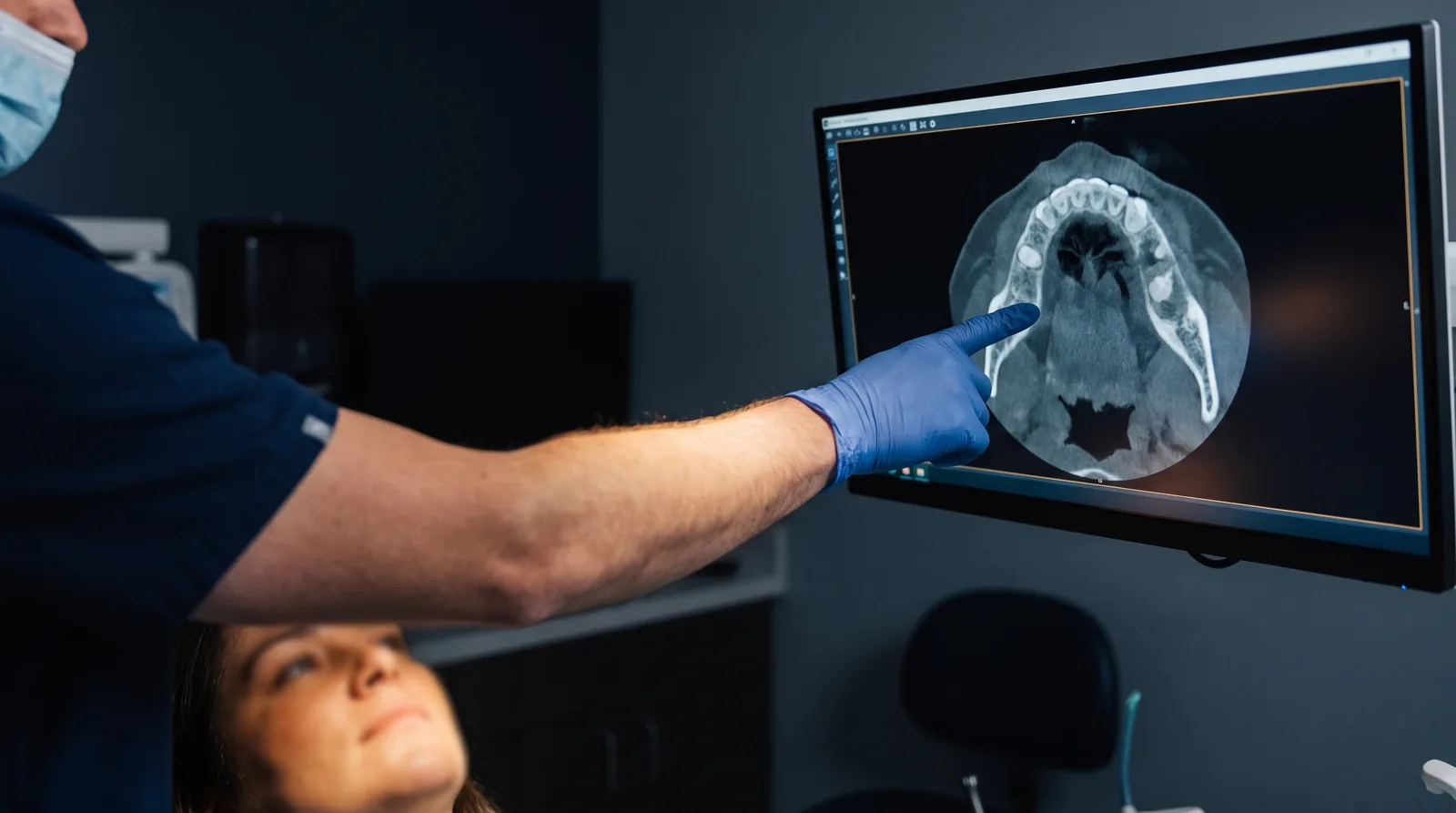
If your provider can show you on your CT scan why the back of your upper jaw needs more support, yes. If you grind your teeth, probably yes. If the recommendation comes without a scan-based explanation, or the practice recommends six for every patient, the extra cost is buying the practice's habit rather than your outcome.
Is All-on-6 more successful than All-on-4?
Not by a margin that shows up clearly in the research. Both approaches report implant survival in the low to mid 90s at ten years and bridge survival higher than that. The studies that compare four and six implants directly tend to find that implant count matters less than bone quality, implant length, surgical skill, and how well the patient cleans the bridge.
Where six implants show a real advantage is in what happens after a single implant fails. With six, the bridge can often be relieved at that site and left in place. With four, the loss of one implant leaves three, which is not enough to support a fixed full-arch bridge, so the patient goes back to a temporary or a denture while the site heals and a new implant integrates.
That difference is about resilience, not initial success. For a patient with good bone and no grinding habit, four implants placed well are expected to last decades. For a patient whose scan shows soft upper bone or whose history includes a failed implant, the two extra implants are insurance worth paying for.
What questions should you ask before choosing four or six?
Ask each provider to answer these in front of your scan, not from memory. A good full-arch surgeon can point to the specific reasons for the count.
- What on my CT scan makes four implants enough, or not enough, for this arch?
- Where will the rear implants sit, and how long is the cantilever behind them?
- If one implant fails in year five, what happens to my bridge?
- Would you recommend the same count if I told you I grind my teeth?
- Does the price change if the count changes during surgery?
- How many arches have you restored with each approach in the last year?
The last question matters more than it seems. Some surgeons trained on the All-on-4 protocol and have hundreds of tilted-implant cases behind them. Others trained on conventional axial implants and are more comfortable placing six. You want the count the surgeon has the most experience delivering, as long as it fits your anatomy. The checklist for choosing an implant provider covers what else to verify before you commit.

What about All-on-5, All-on-8, and other counts?
The number is a clinical variable, not a brand. All-on-5 usually means a four-implant plan with one extra implant added to the arch that needed it, often the upper. All-on-8 is rare and typically reserved for very heavy bites or patients receiving zirconia on both arches with unusually strong bone. Some providers also use the term "Pro Arch" or a manufacturer name for the same concept.
What should stay constant across all of them is the reasoning. If a provider can explain why your upper arch gets six and your lower arch gets four, that is a plan built for you. If every patient in the practice gets the same count, that is a plan built for the practice.
The Bottom Line
All-on-4 and All-on-6 are both proven ways to restore a full arch, and the right number of implants depends on which jaw is being treated, how much bone you have, and how hard you bite. Six implants earn their extra cost in soft upper-jaw bone, in patients who grind, and as insurance against a single implant failing years later. Four implants are the standard for the lower jaw and for patients whose bone will not accommodate more without grafting. Ask every provider to justify the count on your scan, and be wary of any practice that always lands on the same number. And when you are ready, find qualified providers near you at Dental Implant Directory.
Ready to find a qualified provider?
Search our independent directory of dental implant providers organized by specialty, location, and credentials. Find Providers Near You.
Ready to find a qualified provider?
Search our independent directory of dental implant providers organized by specialty, location, and credentials.