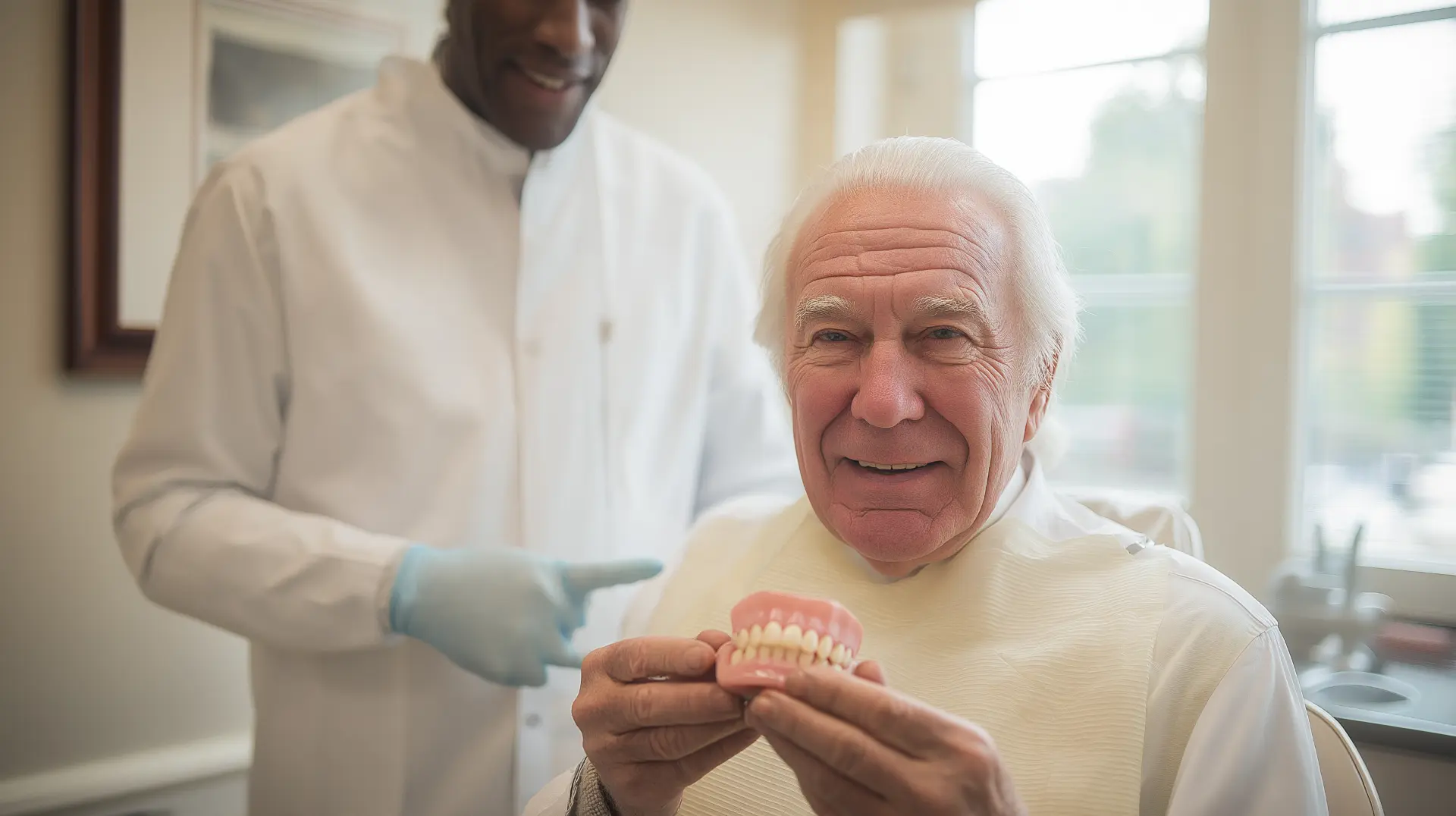
Search "free dentures for seniors" and you get two kinds of results: pages that list programs which stopped taking applications years ago, and ads that collect your phone number for a lead-generation company. The programs that do exist have eligibility rules, wait lists, and limits on what they will do, and none of them hand out implants on request. Knowing that up front saves months of chasing.
The problem is that the need is real and the timeline matters. A person living without teeth loses jawbone every month, eats less protein, and often stops going out. Every year spent on the wrong waiting list makes the eventual treatment harder and more expensive. That is the reason to be precise about which program fits.
This guide covers each program that provides free or reduced-cost dentures or implants to people over 65, what you need to qualify, what it will and will not do, and a realistic timeline for each.
Are there programs that provide free dentures to seniors?
Yes, and they fall into three groups: public insurance, volunteer dentistry, and reduced-fee clinics. Free, complete dentures for an older adult come almost entirely from the first two. The third group cuts the price roughly in half but rarely to zero.
Before going program by program, one rule that applies to all of them: legitimate assistance never charges an application fee and never promises approval before checking your income. There are no federal grants that pay individuals for dentures or implants. A "government dental grant," a "senior implant grant," or a clinic offering free implants before a screening is a marketing funnel or a scam. The programs below are the real ones.
Does Medicaid pay for dentures if you are over 65?
In many states, yes, if you qualify for Medicaid. Adult dental coverage is optional for state Medicaid programs, so the benefit ranges from full dentures with prior authorization to emergency extractions only. In states with an extensive benefit, Medicaid usually covers one set of complete or partial dentures every five to ten years, plus the extractions that come first, with an annual cap that dentures are often exempt from. In emergency-only states, Medicaid pays to pull the tooth and nothing to replace it.
Who qualifies: people over 65 whose income and assets fall under their state's Medicaid limits, which is a much lower threshold than Medicare. Many older adults who qualify are already on Medicare and become what the programs call dual eligible.
What it will not do: Medicaid almost never covers implants for adults. A small number of states cover an implant-retained overdenture in specific medical circumstances, and each one requires prior authorization with documentation from the dentist. Plan on conventional dentures.
Timeline: applying for Medicaid takes weeks to a couple of months. Prior authorization for dentures adds two to six weeks. Finding a dentist who accepts Medicaid for dentures can take longer than either. Ask your state's Medicaid dental administrator for the provider list rather than calling offices cold. Our guide to paying for dental care after 65 lists every state's adult Medicaid dental benefit with a link to the source.
What is Donated Dental Services, and who is eligible?
Donated Dental Services is the volunteer program run by Dental Lifeline Network, and it is the single most important free-dentistry program for older adults in the United States. Volunteer dentists provide comprehensive treatment in their own offices, volunteer dental labs fabricate the dentures and crowns, and the patient pays nothing. The network reports more than 12,000 volunteer dentists and 3,300 labs, and it has delivered more than half a billion dollars in donated care since it began.
Who qualifies: adults who cannot afford treatment and cannot get it through public aid, and who are 65 or older, permanently disabled, or medically fragile. Some states set the age threshold at 60. You apply through your state's page at dentallifeline.org with proof of income and, if applicable, proof of disability. A coordinator reviews the application, adds you to a wait list, and matches you with a dentist when one is available.
What it will and will not do: care is comprehensive, so dentures and partials are common outcomes, and the labs donate the fabrication. Implants are at the volunteer dentist's discretion and are uncommon, because the implant fixture and surgical time are expensive donations. The dentist treats your existing condition once. The program does not provide ongoing care afterward.
Timeline: this is the honest part. Wait lists run months to more than a year, and some states or counties close to new applications when the list gets too long. As of this guide, California's program lists all counties closed to new applicants, and Colorado lists several rural counties closed. Check your state page before you apply, and apply anyway if it is open, because the list only moves for people on it.
Can you get dentures or implants at a dental school for less?
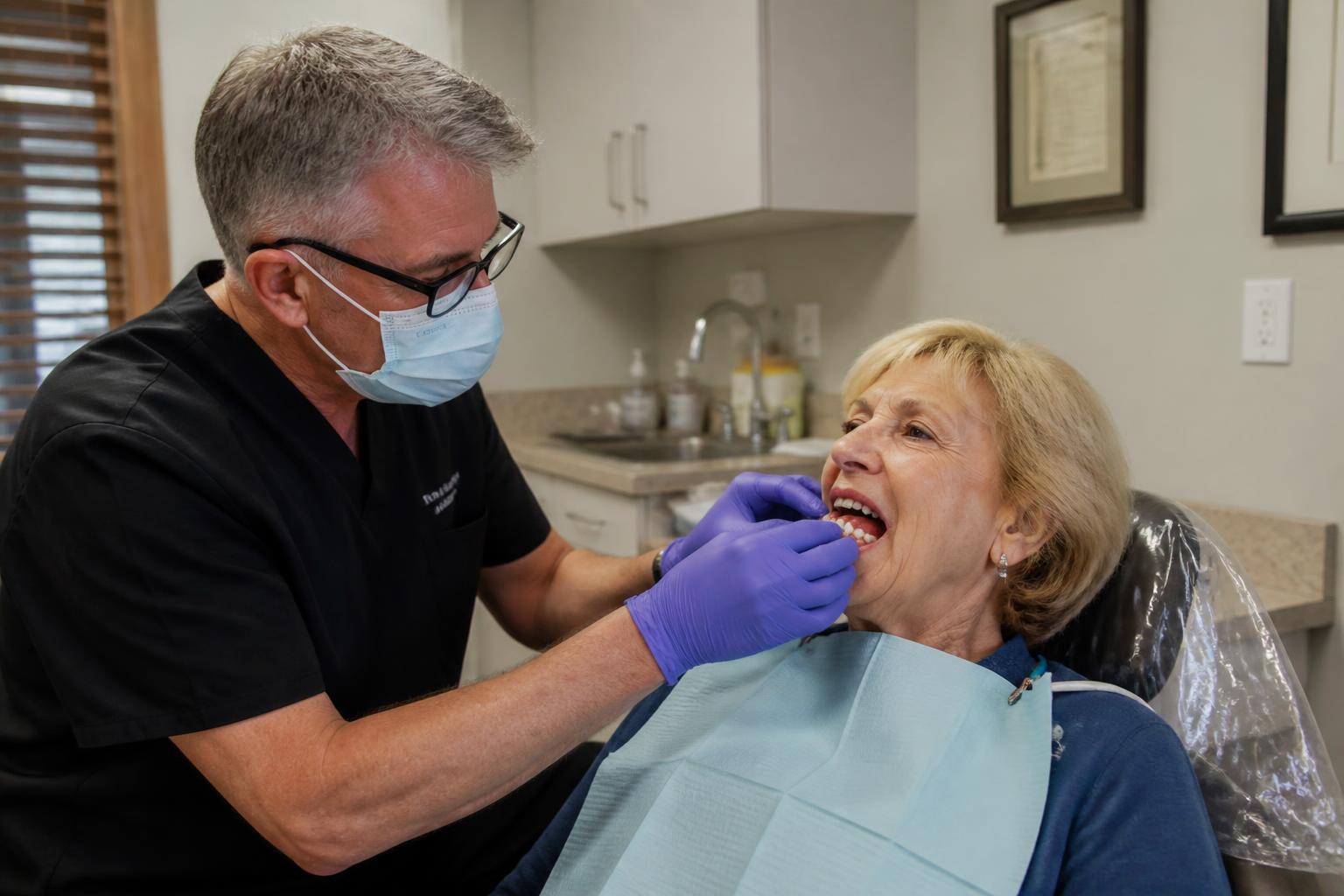
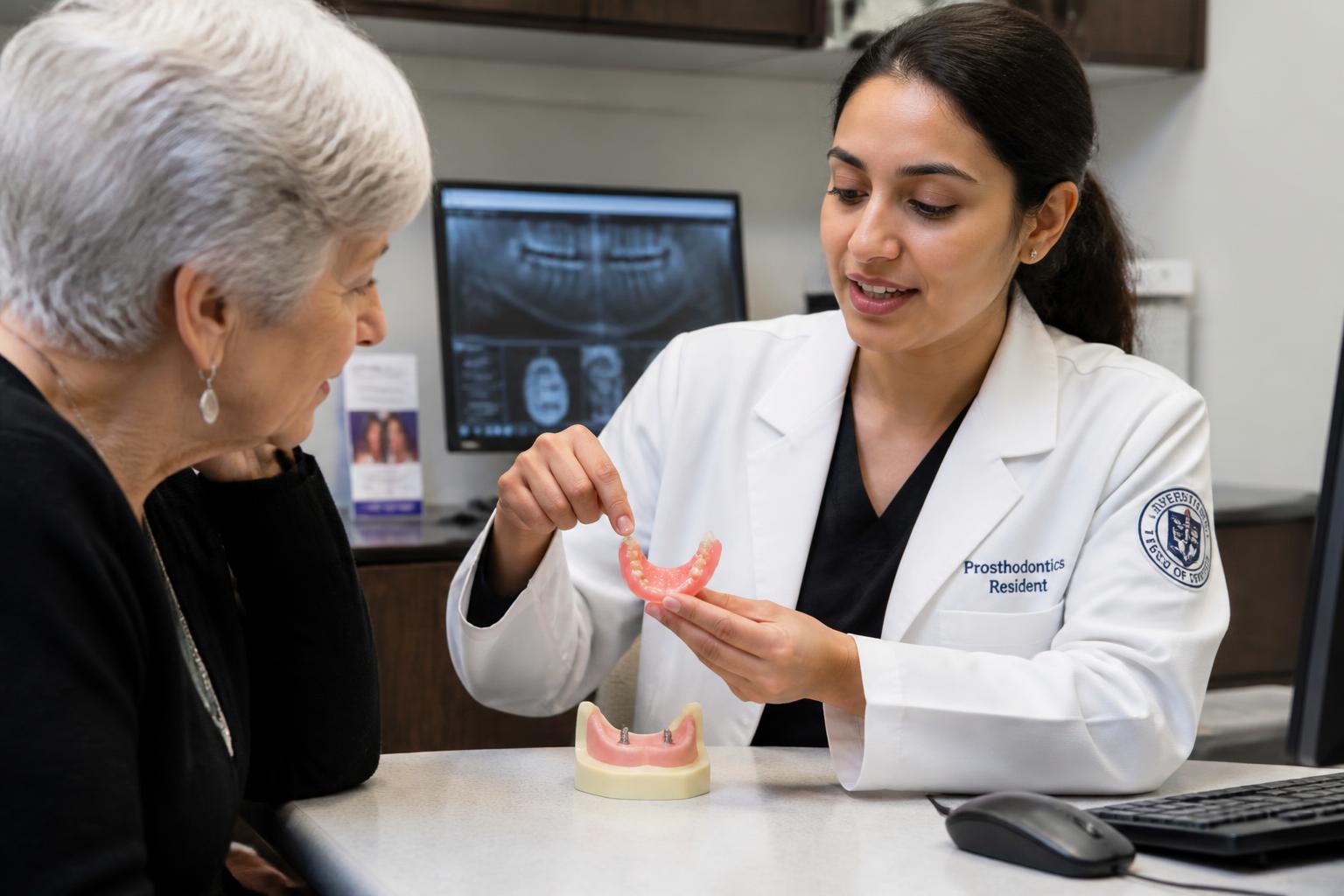
Yes, and dental schools are the best answer for someone who needs implants specifically and cannot pay private-practice prices. Every accredited dental school runs a clinic where supervised students provide care at fees that are often half or less of what a private office charges. Most also run graduate clinics in prosthodontics, periodontics, and oral surgery, where residents who already hold dental licenses place implants and build implant-supported dentures under faculty supervision. Those graduate clinics are where an older adult can get a two-implant overdenture at a fraction of the $5,000 to $8,000 it costs in private practice.
Who qualifies: anyone the school accepts as a patient. There is no income test, but there is a screening visit, and schools select cases that fit their teaching needs. Complex cases with bone loss are often attractive to graduate programs, not disqualifying.
What it will not do: move quickly. A denture that a private office delivers in four visits can take ten at a student clinic. An implant case can span two semesters. Appointments last two to three hours, and you may be reassigned to a new student when the academic year turns over.
Timeline: expect a wait of weeks to a few months to be seen, then several months of treatment. Call the school's patient admissions line, not the department, and ask specifically whether the graduate prosthodontics or implant clinic is accepting new patients. The state-by-state section of the paying for dental care after 65 guide lists the schools in each state with the clinic phone number.
Do community health centers make dentures?
Many do. Federally funded community health centers charge on a sliding scale tied to your income, and the lowest tier is a nominal fee per visit. Health centers cannot turn you away because you cannot pay. Dental services vary by site, and denture fabrication is offered at a subset of them, usually with the lab cost passed through at a reduced rate.
Who qualifies: anyone, with the discount based on household income. Ask the front desk for the sliding fee discount application. Use findahealthcenter.hrsa.gov or call 1-877-464-4772 to find the sites near you, then call each one and ask whether it makes dentures.
What it will not do: implants are rare at health centers. A few larger centers have oral surgery, but the implant fixture cost is outside most sliding-fee models.
Timeline: fastest of any option on this page. New-patient dental appointments are often available within weeks.
What do Mission of Mercy and free clinic events provide?
Mission of Mercy events are two-day free dental clinics run by state dental associations and their foundations, staffed by hundreds of volunteers in a convention center or arena. They provide cleanings, fillings, and extractions to anyone who lines up, first come, first served, with doors opening before 7 a.m. and lines forming hours earlier. America's Dentists Care Foundation keeps a national schedule at adcf.net.
Who qualifies: anyone who shows up. There is no income test and no appointment.
What it will not do: most events do not make dentures, and none place implants. Some events fabricate a limited number of partial dentures on site, and a few offer a denture follow-up program. Treat the event as the way to get infected teeth out for free, which is often the necessary first step before any denture or implant plan.
Are there free dental programs for veterans?
Two, and they matter because only about one in four veterans qualifies for dental care through the Department of Veterans Affairs. VA dental eligibility depends on service-connected dental conditions, disability rating, and former prisoner-of-war status, and a veteran who qualifies can receive dentures and, in some cases, implants at a VA dental clinic. Veterans who do not qualify have one large annual option: Aspen Dental's Day of Service, which opens participating offices nationwide to veterans for free care on a single day each year, November 7 in 2026, with sign-up first come, first served. State dental associations also run veteran-specific Mission of Mercy events in some states.
When do implants make more sense than a free denture?
When the lower denture will not stay in. A conventional upper denture works for most people. A conventional lower denture on a jaw that has been without teeth for years often does not, because there is not enough bone ridge left to hold it, and the tongue and cheeks push it around. For those patients, two implants in the lower jaw with a snap-in overdenture change the outcome more than any other single treatment, which is why prosthodontists treat the two-implant lower overdenture as the standard of care for the fully edentulous lower jaw. Our guide to implant-supported dentures explains how the snap-in design works and what it costs.
The bone argument matters too. A denture sits on the gum and the bone under it keeps shrinking, so the denture needs relining every year or two and replacing every five to seven years. An implant stimulates the bone the way a tooth root does, which is why a denture patient in their sixties often ends up an implant patient in their seventies with less bone to work with. If implants are the eventual answer, the cheapest time is earlier, and the cheapest place for an older adult is usually a dental school graduate clinic.
Age alone is not a reason to rule implants out. Medications and health conditions are what matter, and the guide to what disqualifies you from dental implants covers bisphosphonates, uncontrolled diabetes, and the other real factors.
What order should you apply in?
Most people should run several of these at once, because the waits overlap.
- Check Medicaid eligibility in your state. If you qualify and your state covers dentures, this is the most reliable free path.
- Apply to Donated Dental Services if you are 65 or older (60 in some states) and cannot afford care, as long as your state's list is open.
- Call the nearest dental school's patient admissions line and ask about the graduate prosthodontics or implant clinic. Get on the list.
- Book a new-patient visit at a community health center for anything that cannot wait, including an infected tooth.
- If you are a veteran, check your VA dental eligibility and sign up for the next Day of Service.
- Call the Eldercare Locator at 1-800-677-1116 and ask your Area Agency on Aging for county-level senior dental programs, which exist in some states and are rarely advertised.
The Bottom Line
Free dentures for older adults come from Medicaid in states that cover them and from Donated Dental Services, and both involve an application and a wait. Free implants almost never happen, but dental school graduate clinics place them at a fraction of private-practice cost, and a two-implant lower overdenture is the treatment that most often changes an older denture patient's life. Apply to several programs at once, avoid anything that charges a fee, and get infected teeth out first. And when you are ready, find qualified providers near you at Dental Implant Directory.
Ready to find a qualified provider?
Search our independent directory of dental implant providers organized by specialty, location, and credentials. Find Providers Near You.
Ready to find a qualified provider?
Search our independent directory of dental implant providers organized by specialty, location, and credentials.