
Every implant practice website has a wall of credentials. Fellow of this, Diplomate of that, member of three academies, trained at an institute you have never heard of. The letters are meant to reassure you, and they do, which is the problem: some of them represent years of examined surgical training, and some of them represent a weekend course and an annual membership fee. From the outside they look the same.
The stakes are real because implant placement is not a specialty in most states. Any licensed dentist can place implants after a course, and the credentials are the only signal you have about how much training sits behind the license. Knowing which ones are earned and which are purchased is the difference between choosing a surgeon and choosing a marketer.
This guide explains the credentials you will actually see, what each one requires, and how to verify them before you book.
Is dental implantology a recognized specialty?
Not in most of the United States. The American Dental Association recognizes specialties such as periodontics, oral and maxillofacial surgery, and prosthodontics, each of which involves implants, but it does not recognize implant dentistry as a specialty of its own. A dentist who calls themselves an implant specialist is usually describing a focus, not a credential, and in some states that phrasing is restricted by the dental board.
That is why implant credentials are a mix of specialty certifications, which are examined and regulated, and implant-specific credentials from private organizations, which vary widely in rigor. The guide to which specialist should place your implants covers the specialties. This guide covers the letters.
What does board certification mean for an implant dentist?
Board certification means a dentist completed an accredited residency in a recognized specialty and then passed that specialty's examinations. It is the highest formal credential in dentistry and the most reliable signal of surgical training, but it applies to the specialty, not to implants specifically.
Diplomate of the American Board of Periodontology
A periodontist who has passed the board's written and oral examinations after a three-year residency. Periodontists treat the gums and bone that hold implants and place implants routinely. This is a strong credential for implant surgery.
Diplomate of the American Board of Oral and Maxillofacial Surgery
An oral surgeon who has passed the board's examinations after a four-to-six-year hospital residency. Oral surgeons place implants, perform grafting and sinus lifts, and manage sedation. This is the strongest surgical credential a patient will see.
Diplomate of the American Board of Prosthodontics
A prosthodontist who has passed the board after a three-year residency in restoring teeth. Prosthodontists design and deliver the crowns and bridges that sit on implants, and many also place them. This is the strongest credential for the prosthetic side of a full-arch case.
Board certification in any of these can be verified on the board's website by name. A dentist who claims it but does not appear in the board's directory has not earned it.
What do AAID credentials mean?
The American Academy of Implant Dentistry offers two earned credentials, Associate Fellow and Fellow, and a basic membership that is not earned. The earned credentials require documented cases, continuing education, and written and oral examinations. Membership requires a fee.
Associate Fellow of the AAID
Requires at least 300 hours of implant education, a minimum number of documented implant cases, and passing a written and oral examination. It is a meaningful credential that shows a general dentist has invested heavily in implant training and has been examined on it.
Fellow of the AAID
Requires the Associate Fellow credential plus additional years of experience, more documented cases, and a further examination. It is the AAID's highest credential and represents substantial implant experience.
AAID member
Anyone licensed to practice dentistry can join the AAID by paying dues. Membership on its own indicates interest, not training. A website that says "member of the American Academy of Implant Dentistry" and nothing more is telling you about a subscription.
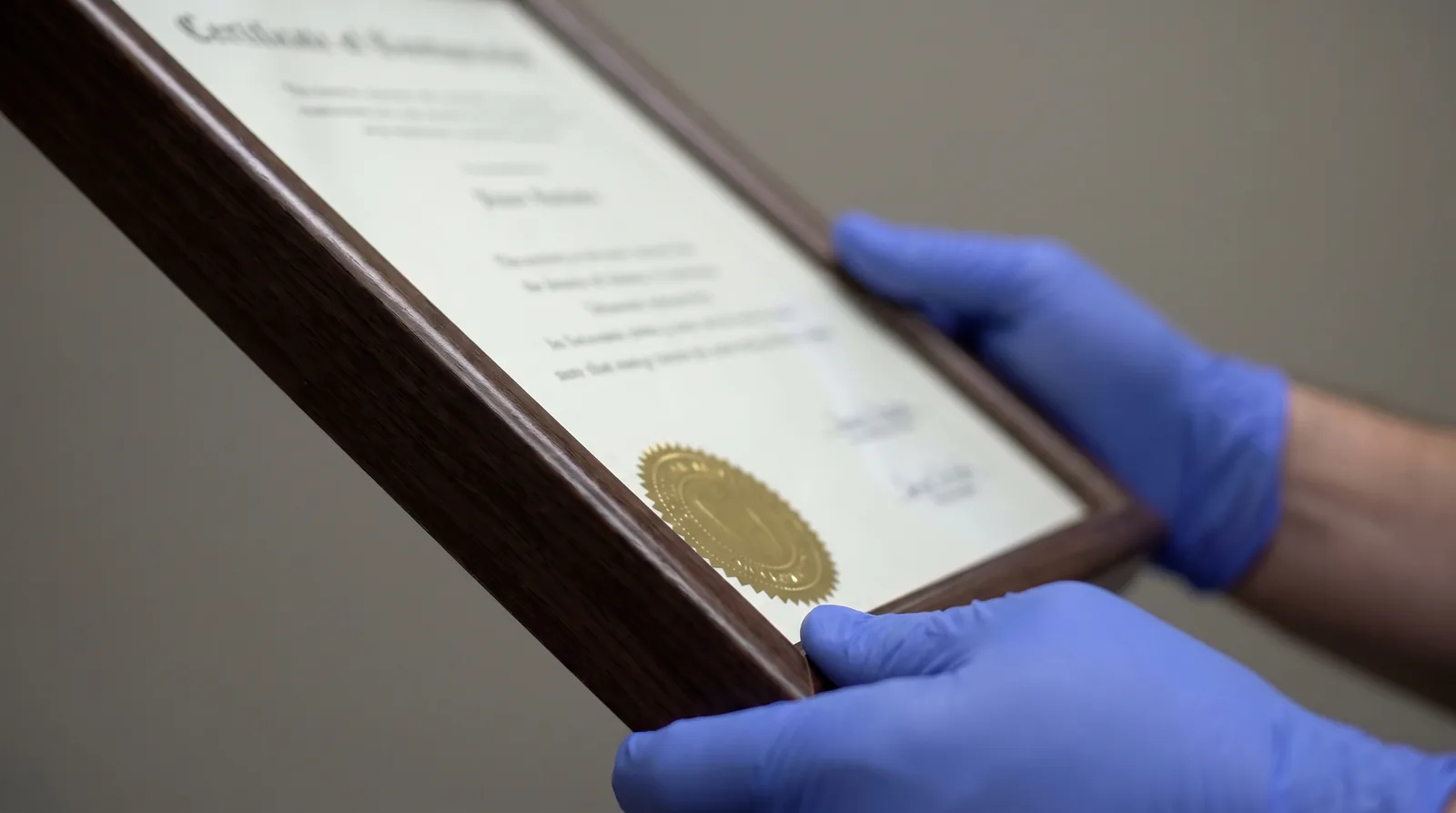
What does Diplomate of the ABOI/ID mean?
Diplomate of the American Board of Oral Implantology/Implant Dentistry is the most rigorous implant-specific credential a general dentist can earn. It requires several years of implant practice, a large number of documented cases across different implant types, and passing a written and an oral examination that reviews the candidate's own cases in detail.
It is not an ADA-recognized specialty board, and some state dental boards restrict how it can be advertised, but the examination itself is demanding and the case requirements are real. A general dentist with ABOI/ID Diplomate status has been examined on implant surgery and restoration by other implant dentists. It is the credential to look for when a general dentist, rather than a specialist, is proposing to place your implants.
What do fellowship and mastership titles from institutes mean?
They vary from serious to meaningless, and the name of the organization tells you which. Fellowships from the Academy of General Dentistry require hundreds of hours of continuing education and an examination, though not implant-specific. Fellowships from the International Congress of Oral Implantologists require a modest number of documented cases and continuing education, with no examination. Fellowships and masterships from private training institutes usually mean the dentist completed that institute's course.
The International Congress of Oral Implantologists
The ICOI is the largest implant organization in the world and its Fellowship and Diplomate credentials require case documentation and education hours but no examination. They indicate real implant activity and are common among competent implant dentists. They are not equivalent to an examined credential.
Institute fellowships
Misch, Kois, Pikos, Spear, and similar names appear on many implant dentists' credentials. These are respected continuing education programs, and completing one represents real training. The credential means the course was completed. It does not mean the dentist was examined by an independent body, and the number of cases required varies by program.
How to read a long list
A dentist with a specialty board certification or an ABOI/ID Diplomate credential has been examined. A dentist with AAID Associate Fellow or Fellow status has been examined. A dentist whose list consists of memberships and institute fellowships has been trained but not independently examined. That is a meaningful difference for a complex case and less important for a straightforward single implant.
Which credentials matter most for a full-arch case?
For All-on-4 and other full-arch work, the surgical credential and the prosthetic credential both matter, because the case has two halves. Look for a surgeon with specialty board certification or ABOI/ID Diplomate status and a restoring dentist with prosthodontic training or a large documented full-arch volume, or a single provider with both.
Full-arch centers often split the work between a surgeon and a restoring dentist. Ask who does each part and what each one's credentials are. The comparison of corporate implant centers and local practices explains why that question matters more at a center than at a single-dentist practice.
How do you verify a credential in five minutes?
Search the credentialing body's directory by the dentist's name, check the state dental board's license lookup for the license and any disciplinary history, and ask the practice for the dentist's case volume in writing. Each step takes a minute or two and catches most exaggeration.
- Board certification: the American Board of Periodontology, Oral and Maxillofacial Surgery, and Prosthodontics each publish a searchable directory of Diplomates.
- AAID credentials: the AAID publishes a directory that distinguishes Fellows, Associate Fellows, and members.
- ABOI/ID: the board publishes a Diplomate directory.
- State license: every state dental board has a public lookup that shows license status and disciplinary actions.
- Case volume: ask how many implants and how many full arches the dentist completed in the past year. Credentials describe training; volume describes current practice.
The checklist for choosing an implant provider covers what to ask once the credentials check out.

Do credentials matter more than experience?
For a routine case, experience matters more. For a complex case, you want both. A general dentist who has placed several hundred implants over a decade with good outcomes is a safer choice for a single implant than a newly certified specialist who has placed forty. For a full arch with bone loss, the specialist's residency training in grafting, sedation, and complications is the thing you are paying for, and volume alone does not replace it.
How to weigh them
Ask for the credential and the number in the same breath. A provider who has both an examined credential and a high annual case volume is the strongest option for any case. A provider with a high volume and no examined credential is fine for straightforward work. A provider with an examined credential and a low volume is fine for straightforward work too, and should be asked how many cases like yours they have done recently. A provider with neither is the one to be careful with.
What outcomes data looks like
Very few practices publish failure rates, but any practice that tracks its cases can tell you roughly how many implants it placed last year and how many failed. A provider who cannot answer either question is not tracking outcomes, which is itself an answer. The guide to All-on-4 problems and failure explains what failure rates in the published literature look like, so you have a benchmark for the answer.
What credentials should make you cautious?
Credentials you cannot find in any directory, specialty claims a state board would not permit, and long lists made up entirely of memberships. None of these mean the dentist is bad. All of them mean the credentials are not telling you what they appear to.
A dentist who describes themselves as a board-certified implant specialist should be able to name the board, and the board should be one of the recognized specialties or the ABOI/ID. A dentist whose implant training consists of a single manufacturer's course is at the beginning of a learning curve, which is fine for a routine case and worth knowing for a complex one. The guide to reading dental implant reviews covers the other half of due diligence.
The Bottom Line
Implant dentistry is not a recognized specialty, so the credentials behind it range from examined specialty boards and the ABOI/ID Diplomate, which represent years of verified surgical training, through AAID Fellowships, which are examined, to institute fellowships and academy memberships, which represent courses taken and dues paid. For a single implant, any trained dentist with real case volume is usually fine. For a full arch, look for an examined credential on the surgical side and prosthodontic training on the restorative side, and spend five minutes verifying both in the credentialing directories. And when you are ready, find qualified providers near you at Dental Implant Directory.
Ready to find a qualified provider?
Search our independent directory of dental implant providers organized by specialty, location, and credentials. Find Providers Near You.
Ready to find a qualified provider?
Search our independent directory of dental implant providers organized by specialty, location, and credentials.