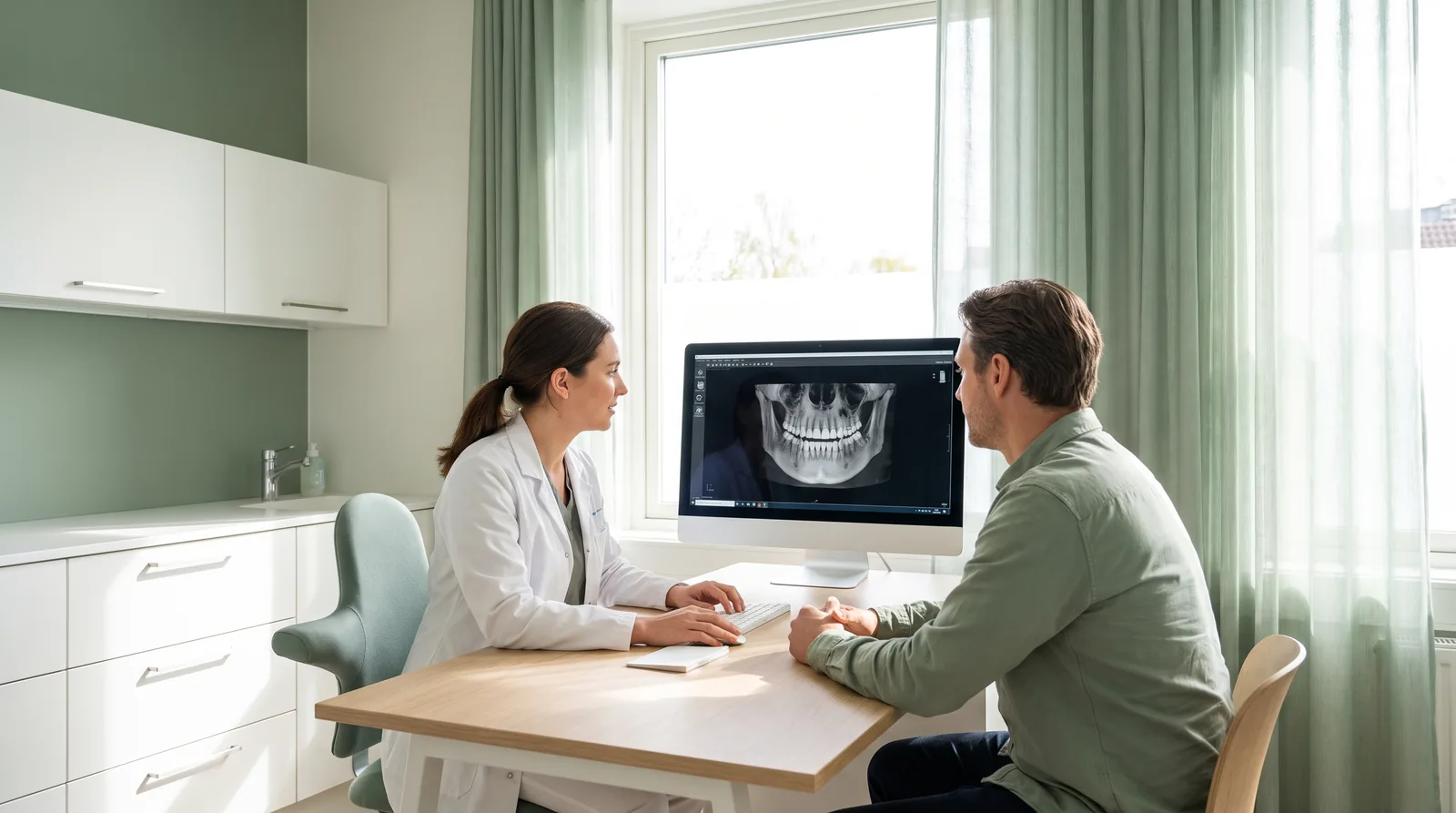
A full-arch treatment plan is a five-figure recommendation from a professional you met an hour ago, based on a scan you cannot read, describing a procedure that will remove every tooth you have left. Most patients accept it or decline it on the spot. Few get a second opinion, partly because it feels like an accusation and partly because nobody tells them how much plans change when a second dentist looks.
They change often. Implant dentistry has more than one right answer for most mouths, and providers differ on how many implants a case needs, whether grafting is required, which teeth can be saved, and what the whole thing should cost. Two honest providers can disagree by tens of thousands of dollars and by the difference between keeping teeth and losing them.
This guide explains which plans deserve a second opinion, how to get one efficiently, and how to decide when the two opinions conflict.
Which dental implant plans deserve a second opinion?
Any plan that removes teeth that are not obviously failing, any full-arch plan, any plan that includes grafting or sinus lifts, any plan quoted without a CT scan, and any plan that feels rushed. A single implant to replace a tooth that is already gone rarely needs one. Almost everything larger does.
Plans that extract salvageable teeth
The most consequential disagreement in implant dentistry is whether teeth should be saved or removed. A full-arch case is simpler for the provider and more profitable than saving six teeth and placing two implants, and some practices recommend it more often than the teeth justify. If your plan removes teeth that do not hurt, are not loose, and have not been declared hopeless by a periodontist, get a second opinion before any extraction. Extractions cannot be undone.
Full-arch plans
All-on-4 and similar plans vary between providers on implant count, bridge material, whether the final bridge is included, and price. A second full-arch quote often differs by $5,000 to $15,000 per arch for the same mouth. The All-on-4 cost breakdown explains what to compare, and the All-on-4 versus All-on-6 comparison explains why the count differs.
Plans with grafting
Bone grafting and sinus lifts add months and thousands of dollars, and whether they are necessary depends on the technique the provider prefers. A surgeon trained on tilted implants may avoid a sinus lift that a surgeon trained on conventional placement would recommend. The guide to All-on-4 with severe bone loss covers when grafting is genuinely required.
Plans quoted without a CT scan
A plan written from a panoramic X-ray or a visual exam is an estimate. A second provider with a CT scan may find the bone is better or worse than assumed, and either changes the plan.
Plans that feel like a sale
If the consultation ended with a financing application before you had an itemized plan, or if the coordinator pushed for a decision that day, that is a reason for a second opinion regardless of what the plan says.
How do you get a second opinion without starting over?
Ask the first practice for a copy of your CT scan and treatment plan, bring both to the second consultation, and tell the second provider you want their independent read. You have a legal right to your records, the scan can be transferred on a disc or a link, and most practices will review an existing scan rather than take a new one.
Getting your records
Request the CT scan in DICOM format, the panoramic X-ray if one was taken, the written treatment plan with codes and prices, and any photographs. Practices may charge a small copying fee. They may not refuse.
Choosing the second provider
Pick a different type of provider from the first. If the first was a corporate full-arch center, see an independent periodontist or oral surgeon. If the first was a general dentist, see a specialist. Different training produces different plans, and the difference is the information you are paying for. The guide to which specialist should place your implants explains how each one approaches a case.
What to say
Tell the second provider what the first recommended and ask whether they agree, without saying which way you are leaning. Then ask what they would do differently and why. A provider who can point to the scan and explain a different plan is giving you something useful. A provider who simply matches the first plan or undercuts it on price is not.

What does a second opinion cost?
Usually a consultation fee of $0 to $300, and often less if you bring your own scan. Some practices waive the fee if you proceed with treatment. Compared with the plan it is checking, which may run $25,000 or more, it is the cheapest step in the process.
Insurance sometimes covers a second-opinion consultation as an exam. Ask the practice to submit it that way.
What do you do when the two opinions disagree?
Find out where the disagreement is, ask each provider to respond to the other's reasoning, and if the gap is about whether teeth can be saved, see a periodontist to settle it. Disagreements about price are easy to resolve. Disagreements about anatomy and prognosis need a third set of eyes.
Disagreement about extractions
This is the one that matters most, because it is irreversible. A periodontist is the specialist trained to judge whether a tooth can be kept, and a periodontal exam with probing depths and X-rays gives a documented answer. If the periodontist says the teeth are salvageable, the full-arch plan is premature.
Disagreement about implant count or grafting
Ask each provider to show you on the scan why they chose their approach. A provider who can explain the bone density and the sinus position in terms you can follow is reasoning from your anatomy. A provider who cannot is reasoning from habit.
Disagreement about price
Compare itemized plans line by line. Most price gaps come from what is included, not from a different price for the same thing. The guide to how much dental implants cost explains what a complete quote contains.
When to get a third
If two providers disagree about extractions or about whether you are a candidate at all, a third opinion from a specialist is worth the fee. If they disagree only about price and material, two is enough.
What should a second opinion cover for a full-arch case?
Whether any teeth can be saved, the implant count and why, whether grafting is needed, which bridge material is proposed, whether the final bridge is in the price, and what maintenance will cost. A second opinion that addresses all six has examined the case. One that addresses only the price has not.
Teeth
Ask the second provider to go tooth by tooth on the ones the first plan removes. For each, the answer should be a reason: fractured below the gum, bone loss past a stated point, failed root canal, or a strategic reason related to the bridge. "They will fail eventually" is not a reason to remove a tooth today.
Implants and bone
Ask where each implant would go on your scan and why that number. Then ask whether grafting is required and what would happen without it. The All-on-4 with severe bone loss guide describes how the same scan can support different approaches.
The bridge
Ask which material, whether the final is included, and what the temporary-to-final process looks like. The temporary versus final teeth guide explains why this question catches the most common quote omission.
After
Ask what annual maintenance costs and what the warranty covers. The guide to implant warranties explains what a real guarantee looks like.
Will the first provider be offended?
A good one will not. Second opinions are routine in every surgical field, and a provider who reacts badly to one has told you something about how they will react to a complication. Most practices expect full-arch patients to consult elsewhere and will hand over records without comment. The checklist for choosing an implant provider treats the second opinion as a standard step, not an exception.
What are the signs a second opinion changed the right things?
You understand why each tooth is being kept or removed, the implant count and any grafting are explained on your scan, the quote is itemized with the final teeth included, and the price difference between the two plans is accounted for by what each includes. If the second opinion produced those four things, it did its job whether or not you switch providers.
- Every extraction has a reason you can repeat back.
- Implant count and grafting are justified on the CT scan.
- The plan is itemized and includes the final prosthesis.
- The price gap between plans is explained by content, not mystery.
- You know who will place the implants and who will make the teeth.
The Bottom Line
Get a second opinion on any implant plan that removes teeth that are not clearly failing, on any full-arch plan, on any plan with grafting, and on any plan quoted without a CT scan. Bring your existing scan and plan to a different type of provider, ask what they would do differently and why, and if the disagreement is about whether teeth can be saved, let a periodontist settle it. It costs a consultation fee at most and it changes plans often enough to be the best-value step in the entire process. And when you are ready, find qualified providers near you at Dental Implant Directory.
Ready to find a qualified provider?
Search our independent directory of dental implant providers organized by specialty, location, and credentials. Find Providers Near You.
Ready to find a qualified provider?
Search our independent directory of dental implant providers organized by specialty, location, and credentials.