One missing tooth, two ways to replace it, and a price gap of a few thousand dollars between them. A fixed bridge is faster and cheaper on day one. An implant costs more and takes months. Most patients are quoted one or the other depending on what the dentist prefers to do, and few are walked through why the answer might differ for their particular tooth.
The difference is not mainly about the missing tooth. It is about the two teeth on either side of it. A bridge uses them as anchors, which means grinding them down and loading them for the rest of their lives. An implant leaves them alone. Over twenty years that difference shows up as root canals, crowns, and sometimes the loss of teeth that were healthy when the bridge went in.
This guide compares the two on cost, longevity, what they do to your other teeth, and daily life, and identifies the cases where a bridge is still the better call.
What is the difference between a dental implant and a bridge?
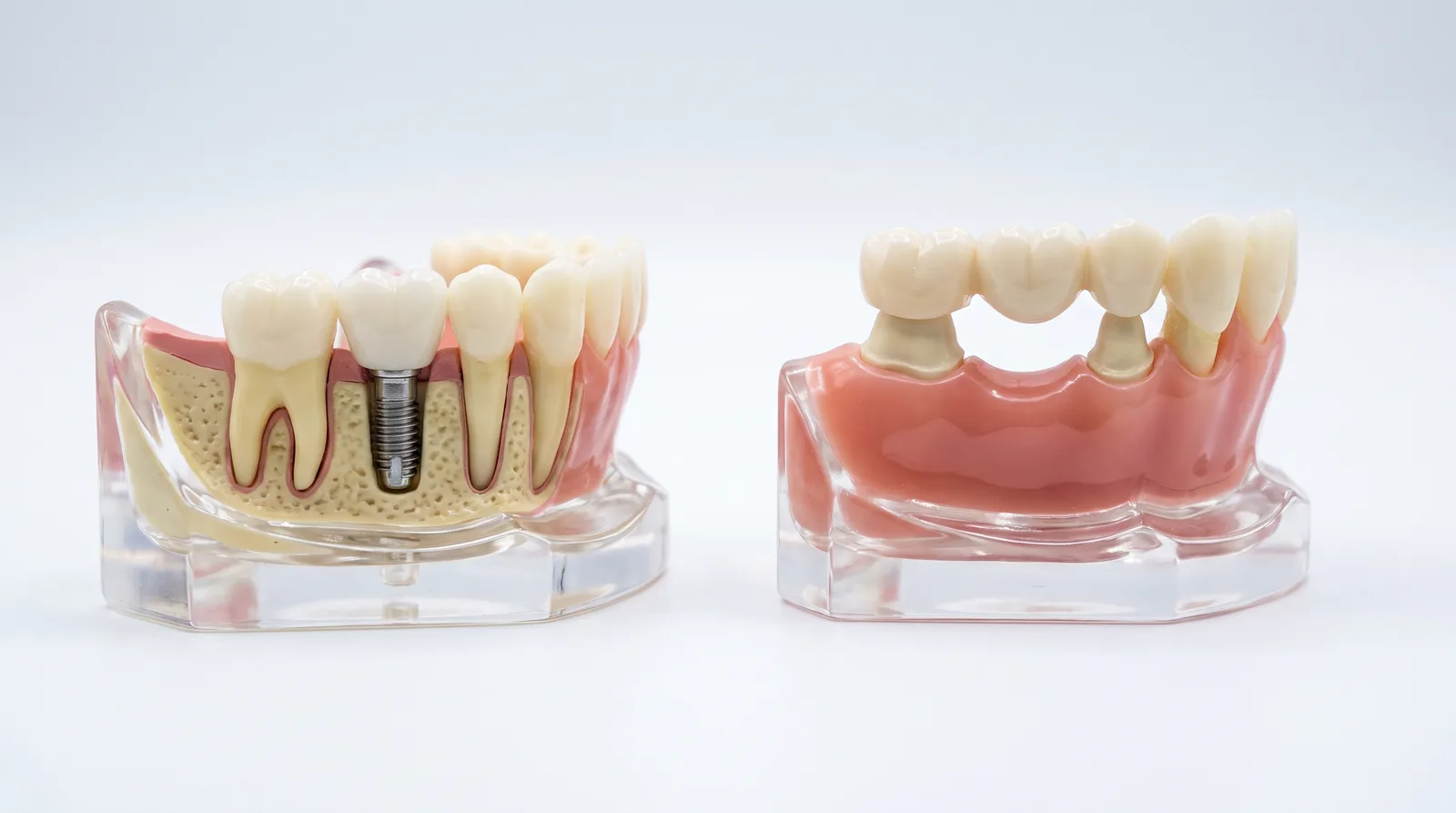
An implant replaces the missing tooth with a titanium post in the bone and a crown on top, and touches nothing else. A fixed bridge replaces the missing tooth with an artificial tooth suspended between crowns on the two neighboring teeth, which are reshaped to hold them. The implant is a standalone tooth. The bridge is a three-unit structure that depends on its neighbors.
Both are fixed, meaning neither comes out. Both look like a natural tooth when done well. The engineering underneath is what separates them.
How do a dental implant and a bridge compare on cost?
A single implant with abutment and crown runs $3,500 to $6,500 in 2026, and more if grafting is needed. A three-unit bridge runs $2,500 to $5,000. The bridge is cheaper up front by roughly $1,000 to $2,500 in most markets. Over twenty years the gap closes and often reverses, because bridges are replaced sooner and their anchor teeth need work.
The day-one number
The bridge wins. It is also faster, usually two visits over two to three weeks, against three to six months for an implant to integrate before the crown goes on. For a patient who needs a tooth replaced quickly and cheaply, the bridge has a real case.
The twenty-year number
An implant placed at $5,000 with one crown replacement at around $1,500 totals roughly $6,500. A bridge at $4,000 replaced once at $4,500 totals $8,500, plus whatever the anchor teeth need along the way, which is often a root canal or a new crown and sometimes an extraction. The guide to whether dental implants are worth the cost runs the full comparison.
Insurance
Dental plans that exclude implants often cover bridges at 50 percent as a major service, which narrows the day-one gap further. Some plans that exclude implants will apply the bridge benefit to the implant under an alternate benefit clause. The guide to dental insurance and implants explains how to ask.

How long does a dental implant last compared with a bridge?
An implant fixture is expected to last decades, with survival above 95 percent at ten years, and its crown lasts ten to fifteen years before replacement. A bridge lasts ten to fifteen years on average and fails when decay develops under one of the anchor crowns or an anchor tooth fractures under the extra load. The guide to how long dental implants last gives the survival figures by year.
Why bridges fail
A bridge cannot be flossed normally, because the three units are joined. Plaque collects under the false tooth and at the edges of the anchor crowns, and decay starts where the crown meets the tooth. The anchor teeth also carry the chewing load of three teeth, which stresses their roots. When a bridge fails, it usually takes an anchor tooth's health with it.
Why implants fail
Mostly from infection around the implant over years, driven by smoking, gum disease history, and missed cleaning. The guide to peri-implantitis covers it. Implants do not decay and do not depend on neighbors.
What does each option do to the neighboring teeth?
A bridge requires grinding down the two neighboring teeth to stubs so crowns can fit over them, which removes healthy enamel permanently and commits those teeth to a lifetime of crowns. An implant leaves them untouched. This is the single largest difference between the two options and the one most patients are not told about.
When the neighbors already have crowns
If both neighboring teeth already have large fillings or crowns, the bridge costs them little, because they have already been reshaped. This is the situation where a bridge is most defensible.
When the neighbors are healthy
Grinding down two healthy teeth to replace one missing tooth turns a one-tooth problem into a three-tooth commitment. Most dentists who place implants would recommend an implant here, and most patients who understand the trade would choose it.
What does each option do to the jawbone?
An implant preserves the bone at the site because it loads the bone the way a root did. A bridge does not, and the bone under the false tooth resorbs over years, leaving a visible dip in the gum and sometimes a gap under the bridge that traps food. For a front tooth, that bone loss eventually shows.
Which is better for a front tooth?
Usually an implant, for bone preservation and because the neighbors are often healthy, with the caveat that a front implant is the most demanding kind to make look natural and requires a provider with the skill to manage the gum. A bridge can look excellent on day one and then develop a dark line or a gum dip as the bone recedes. For a patient with thin gum or a high smile line, the provider's experience matters more than the choice of option.
When is a bridge the better choice?
When the neighboring teeth already need crowns, when the patient cannot have surgery or cannot wait months, when bone at the site is too poor for an implant without grafting the patient does not want, when the budget is fixed and insurance covers the bridge, and when the missing tooth sits between two teeth that are already joined by dental work. In those cases a bridge is a good treatment, not a compromise.
- Both neighbors already have crowns or large fillings.
- Surgery is not an option for medical reasons. The guide to what disqualifies patients from dental implants covers the conditions that matter.
- The patient needs the tooth replaced within weeks.
- The site would need extensive grafting for an implant.
- Insurance covers the bridge and excludes the implant, and the day-one gap is decisive.
What is a cantilever bridge or a Maryland bridge, and do they change the comparison?
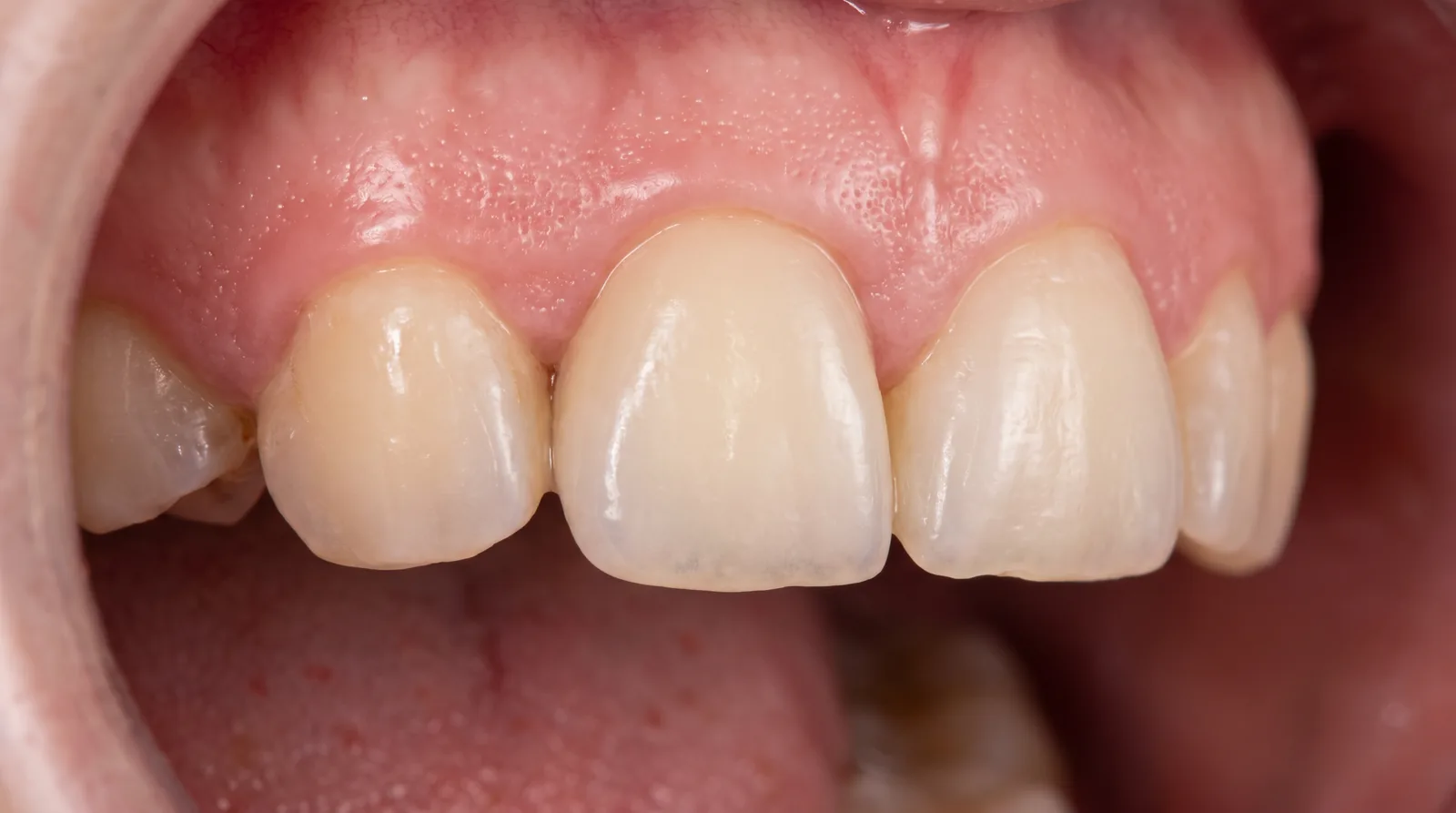
A cantilever bridge anchors the false tooth to only one neighboring tooth, and a Maryland bridge bonds a false tooth to the backs of the neighbors with metal or ceramic wings instead of crowns. Both spare more tooth structure than a conventional bridge and both have shorter lifespans and narrower uses.
Maryland bridges
Useful for a front tooth in a light bite, especially as a long-term temporary while an implant site heals or for a younger patient whose jaw is still growing. They debond over time and are not suited to back teeth. For an adult replacing a front tooth permanently, they are a bridge to an implant more often than a substitute for one.
Cantilever bridges
Load one anchor tooth with two teeth of chewing force, which is why they are used sparingly and almost never for molars. They preserve the second neighbor but ask more of the first.
How they change the decision
They do not change the core comparison for a single missing tooth in an adult with healthy neighbors, where an implant still wins on longevity and preserving tooth structure. They widen the options for a patient who cannot have an implant now, and a Maryland bridge is a reasonable way to hold a front space while bone heals or money is saved.
What should you ask before choosing?
Whether the neighboring teeth are healthy, what the bone at the site looks like on a scan, what each option costs itemized, what each will cost over twenty years, and what happens to the anchor teeth if a bridge fails. A provider who offers only one option without explaining the other is describing their preference, not your case.
- Are the teeth on either side healthy, or do they already need crowns?
- Is there enough bone for an implant without grafting?
- What is the itemized cost of each, including the crown?
- What does each option look like over twenty years?
- If the bridge fails, what happens to the anchor teeth?
- For a front tooth, can I see photographs of your implant results?
The checklist for choosing an implant provider covers what to verify once the option is chosen.
The Bottom Line
For one missing tooth between two healthy neighbors, an implant is usually the better choice: it leaves the neighbors alone, preserves the bone, lasts longer, and costs less over twenty years despite costing more on day one. A bridge is the better choice when the neighbors already need crowns, when surgery or a months-long timeline is not an option, or when the site would need grafting the patient does not want. Ask about the neighbors and the bone before you ask about the price. And when you are ready, find qualified providers near you at Dental Implant Directory.
Ready to find a qualified provider?
Search our independent directory of dental implant providers organized by specialty, location, and credentials. Find Providers Near You.
Ready to find a qualified provider?
Search our independent directory of dental implant providers organized by specialty, location, and credentials.