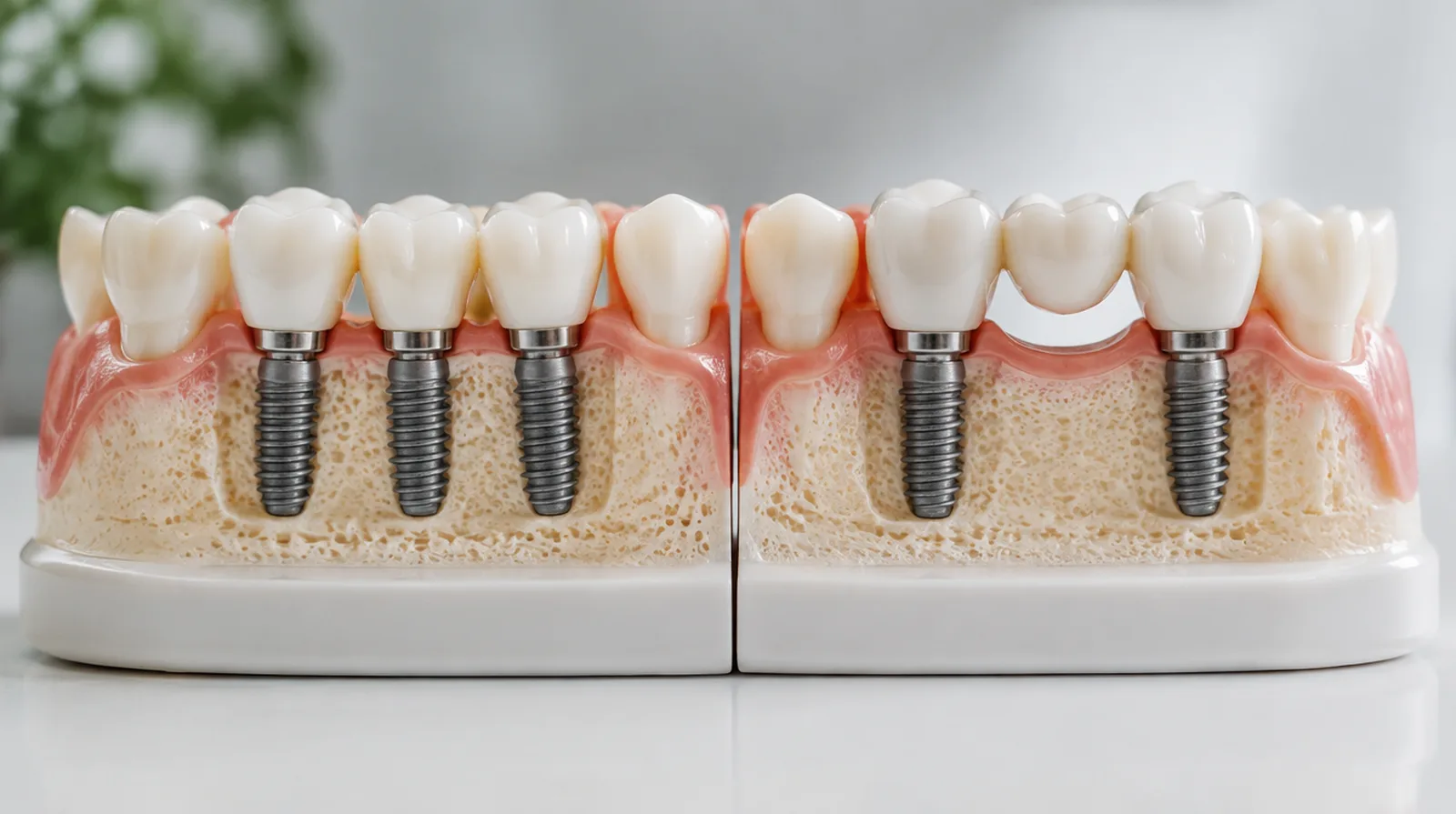
A patient missing three teeth in a row will get one of two plans depending on the provider. One says three implants, three crowns, one for each tooth. The other says two implants with a three-unit bridge between them. The difference on the quote is several thousand dollars, and the difference in the mouth is invisible from the outside. Most patients are not told there are two options, let alone why one was chosen.
Both are good treatments. The choice depends on where the teeth are, how much bone is there, how hard the patient bites, and how they will clean the result. A provider who always does one or always does the other is following a habit, and the habit may or may not fit your case.
This guide explains when an implant bridge is the right call, when individual implants are, and what the trade is between them.
What is an implant-supported bridge?
Two or more implants supporting a bridge that replaces more teeth than there are implants. The most common version is two implants supporting three teeth, with the middle tooth suspended between them. Longer spans, such as three implants supporting four or five teeth, are used when the bone and bite allow. It is the same idea as a conventional bridge, with implants as the anchors instead of ground-down natural teeth.
What are individual implants for multiple teeth?
One implant and one crown for each missing tooth, each standing on its own. Three missing teeth means three implants and three crowns. Each tooth can be flossed like a natural tooth, each crown can be replaced independently, and each implant carries only its own load.
How do the two options compare on cost?
An implant bridge costs less because it uses fewer implants. Two implants and a three-unit bridge typically run $7,000 to $12,000 in 2026, against $10,000 to $18,000 for three implants and three crowns. The saving is roughly one implant fixture and one surgery site, minus the extra lab cost of a bridge. The guide to how much dental implants cost shows where each component sits in a quote.
For four or five adjacent teeth the saving grows, because two or three implants can do the work of four or five. That is why implant bridges are common in the back of the mouth, where several molars and premolars are often missing together.
How do they compare on bone requirements?
Individual implants need adequate bone at every tooth position. An implant bridge needs it only at the anchor positions, which lets the provider skip a site with poor bone and span it instead. This is often the deciding factor: a patient with a sinus that has dropped over one molar position can have implants on either side of it and a bridge across, avoiding a sinus lift. The guide to bone grafting before implants covers when spanning a site is an alternative to grafting it.

How do they compare on cleaning and maintenance?
Individual implants are cleaned like natural teeth, with floss between each one. An implant bridge has to be cleaned underneath the suspended tooth with a floss threader, a water flosser, or interdental brushes, because the units are joined. Patients who clean well manage either. Patients who do not will develop inflammation under a bridge sooner. The guide to peri-implantitis explains why cleaning around implants matters more than around teeth.
How do they compare on repairs?
An individual crown that chips is replaced alone. A bridge that chips is usually remade as a unit, at greater cost. If an implant fails under individual crowns, only that tooth is affected. If an anchor implant fails under a bridge, the whole bridge comes off until the implant is replaced. Individual implants are the more resilient design. The guide to how long dental implants last covers the lifespan of crowns and bridges on implants.
How do they compare on appearance?
In the front of the mouth, individual implants usually look better, because each tooth can emerge from the gum with its own contour and the papillae, the small triangles of gum between teeth, are easier to preserve. A front bridge can look excellent from a skilled lab, but the suspended tooth has no root beneath it and the gum under it flattens over time. In the back, appearance matters less and a bridge is rarely visible.
When is an implant bridge the better choice?
For several adjacent missing back teeth, when one site has poor bone, when the budget favors fewer implants, and when the patient's bite is not unusually heavy. In those situations a bridge delivers the same function for less money and less surgery.
- Three or more adjacent teeth missing in the back of the mouth.
- One position in the gap has bone that would need grafting for an implant.
- The saving of one or two implants matters to the budget.
- The patient does not grind heavily and cleans well.
When are individual implants the better choice?
For front teeth where appearance matters, for patients who grind or clench, for patients who want the simplest cleaning and the most repairable result, and for two adjacent missing teeth, where a bridge saves nothing because two implants are needed either way.
- The missing teeth are in the smile zone.
- The patient grinds or has a heavy bite that would overload a bridge.
- The patient wants floss-only cleaning and independent repairs.
- Only two teeth are missing.
- Bone is good at every site, so there is no site to span.
How long can an implant bridge span?
Two implants comfortably support three teeth, and three implants support four or five, depending on the position in the mouth, the bone quality, and the patient's bite. Longer spans on fewer implants put more leverage on each fixture and are avoided in the back of the mouth, where forces are highest. A cantilever, a tooth suspended beyond the last implant with no support on one side, is used sparingly and kept short.
Front versus back
In the front, lighter forces allow longer spans and cantilevers are more acceptable. In the back, most providers keep to one implant per tooth or two implants for three teeth at most, and place the implants at the ends of the span rather than the middle.
Why the surgeon's judgment matters
Span length is a planning decision made from the CT scan, the opposing teeth, and the patient's habits. A grinder gets shorter spans and more implants. A patient with a light bite and good bone can have longer spans and fewer. The checklist for choosing an implant provider covers how to judge the provider making that call.
What about a full arch?
Once most or all teeth in an arch are missing, the conversation shifts to full-arch designs, which are implant bridges on a larger scale. A single All-on-4 bridge, a segmented 3-on-6 arrangement, or an implant-supported denture are the usual options, and each is a different trade between cost, cleaning, and appearance. The full mouth cost guide compares them, and the 3-on-6 guide covers the segmented approach, which is essentially three implant bridges applied to a whole arch.

What should you ask when several teeth are missing?
Which design is proposed and why, what the other design would cost, what the bone looks like at each position, and how the result will be cleaned. A provider who explains the choice on your scan is planning your case. One who names a design without explaining it is describing their default.
- Are you proposing a bridge or individual implants, and why for my case?
- What would the other option cost here?
- Which positions have good bone and which would need grafting?
- How will I clean it, and what tools will I need?
- If one implant fails, what happens to the rest of the restoration?
- Who designs the bridge, and can I see photographs of similar cases? The guide to what a prosthodontist does explains why the design matters.
The Bottom Line
For several adjacent missing back teeth, an implant-supported bridge on two or three implants replaces them for less money and less surgery than one implant per tooth, and lets the provider span a site with poor bone instead of grafting it. For front teeth, heavy biters, patients who want floss-only cleaning, and gaps of only two teeth, individual implants look better, clean easier, and are repaired one tooth at a time. Ask which design is proposed, why, and what the alternative would cost, and expect the answer to come from your scan. And when you are ready, find qualified providers near you at Dental Implant Directory.
Ready to find a qualified provider?
Search our independent directory of dental implant providers organized by specialty, location, and credentials. Find Providers Near You.
Ready to find a qualified provider?
Search our independent directory of dental implant providers organized by specialty, location, and credentials.